Qingyuan moksha Biotechnology Co., Ltd


Encapsulation is one of the few formulation technologies that a consumer can see. Suspended beads in a shampoo, visible pearls in a shower gel, a serum that breaks into droplets on the skin: all of these are the same underlying idea, which is to hold an ingredient inside a protective shell and release it at a chosen moment. Microcapsule technology is not a marketing layer added to a formula; it changes how the formula must be built. This article explains what encapsulation does, where it pays off, and what to verify before committing to a programme.
What Encapsulation Actually Does
A microcapsule is a small shell, usually a polymer, lipid or polysaccharide, surrounding an active or a fragrance. The shell keeps the payload separate from the rest of the formula until a trigger releases it, and that trigger can be water, friction, temperature or pH. Separation is the core benefit: ingredients that would react with each other in one phase can coexist in a single product. A second benefit is protection, since a shell shields sensitive actives from oxygen, light and the heat of processing.
Where the Technology Changes a Formula
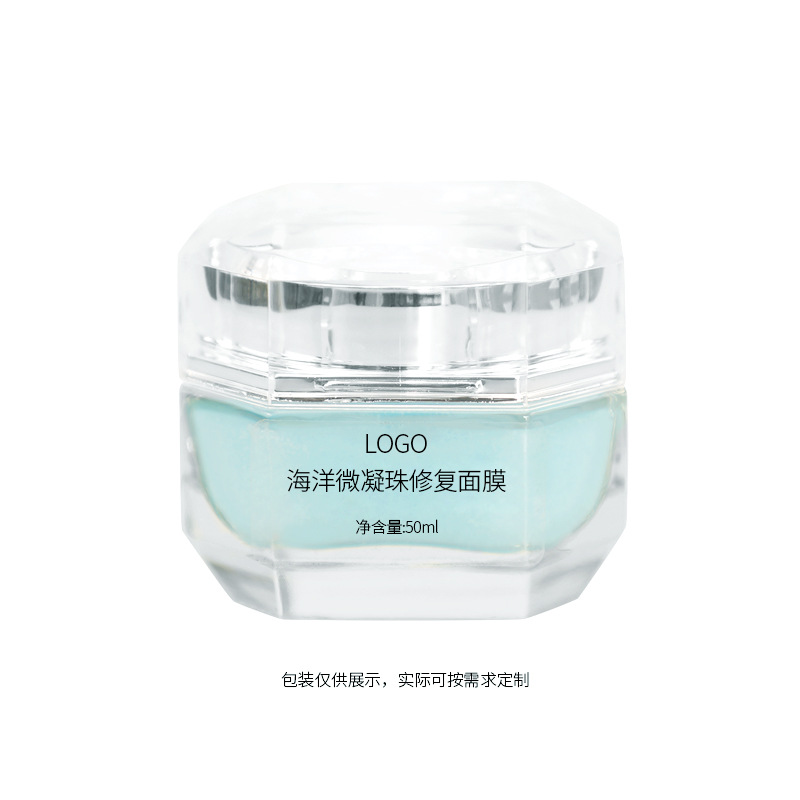
Encapsulation affects texture, stability and cost in ways that are easy to underrate. Visible capsules impose a particle size and density requirement on the base formula, or they float, sink or dissolve too early. Surfactant-heavy products such as cleansers and shampoos are the hardest environment, because the shell must survive a concentrated surfactant system for months and still break on use. Leave-on products with low water activity are more forgiving. The current range includes formats built around this approach, such as this encapsulated repair mask, and comparable items in the product range.
Release profile is the real specification
When a supplier says a capsule contains a given active, the useful follow-up question is what fraction of it actually releases, and when. Encapsulation efficiency, payload loading and release rate are measured properties, not claims. Ask for the release profile in the same base formula you intend to sell, not in water.
Cost, MOQ and Sourcing Signals
Encapsulated raw materials cost more per kilogram than their unencapsulated equivalents, and they often carry a higher minimum order quantity because they are produced in dedicated batches. Budget for the encapsulated raw material as a fixed cost before the rest of the formula is priced, since retrofitting it later usually means redesigning the base. Shelf life is another practical limit: capsules can settle, aggregate or leak over time, so the declared shelf life may be set by the capsule rather than by the preservative system. Ask what the capsule supplier's own retest data shows at the end of the intended shelf life. Manufacturer capabilities are summarised on the about us page.
Verification Before Bulk Production
Encapsulated products need stability testing that looks at the capsule specifically, not only at the emulsion. Inspect capsule integrity by microscopy at each stability checkpoint rather than relying on appearance alone, and check colour and odour drift, since a leaking payload often shows up as a change in either. If capsules are meant to remain visible, confirm the fill process does not damage them; pump and valve geometry can crush shells that survive mixing. Process damage is a common cause of capsules that look correct in a sample jar and fail in a filled unit. Production conditions are described in the workshop overview.
Encapsulation is worth adopting when it solves a real technical problem: incompatible ingredients, a fragrance that fades, an active that degrades, or a visible cue that the brand wants. Adopt it for the function, and the visual benefit comes for free. Send your concept through the contact page and the manufacturer can confirm whether the format is feasible in your chosen base.
Frequently asked questions
Can you produce Microcapsule Technology in Skincare under our own brand?
Microcapsule Technology in Skincare is handled as a private label project: you bring the brand and the market position, we cover formula, bulk, filling and packing. Existing bases can be adjusted for texture, fragrance and active level, or we develop from a new brief. Tooling and artwork belong to you, and our name does not appear on the pack.
What is the minimum order quantity?
MOQ is set by net fill per unit, not by category:
| Net fill | MOQ |
|---|---|
| < 15 ml/g | 5,000 pcs |
| 15-50 ml/g (50 included) | 3,000 pcs |
| 50-200 ml/g (200 included) | 2,000 pcs |
| > 200 ml/g | 1,000 pcs |
Several SKUs in one project can share a production run to reach the threshold, and a smaller trial order is possible once the formula is approved.
How long do samples and bulk production take?
Samples take 7-10 working days from a confirmed brief, or 10-15 days when a new mould or artwork is involved. Bulk runs 25-35 days after sample approval and packaging arrival. Repeat orders with an unchanged formula usually move faster.
Which certificates and documents come with the shipment?
The plant runs under GMPC and ISO 22716 with a 100,000-class cleanroom. Each shipment can include COA, MSDS, the full INCI list, stability data and microbiological reports. For the EU we support CPSR and PIF paperwork; for other markets we prepare the file set your importer asks for.
Can we change the formula, fragrance or packaging?
Yes. Texture, viscosity, fragrance, colour and active percentage are adjustable within regulatory limits. Packaging can be sourced by you or by us: tubes, airless bottles, jars, sachets and aluminium foil bags, with silkscreen, hot stamping or label application.
What information do you need to quote?
Category and target function, quantity per SKU, packaging direction, destination market and launch date. With that we reply within 24 hours on business days with feasibility, MOQ and a price range. An NDA can be signed before formulas are discussed.
Need this produced? Talk to the factory.
Wangsha Bio has run OEM/ODM production since 2006: 60,000 sqm plant, 17 lines, 100,000-class cleanroom, GMPC and ISO 22716 certified. Send your brief and we reply within 24 hours on business days with feasibility, MOQ and a price range.
Email lucky@moksha-bio.com | Product range | Workshop