Qingyuan moksha Biotechnology Co., Ltd


Acid exfoliation dominates the conversation, but enzymes offer a different route: they break down dead skin cell bonds without the sting and without the pH constraints of an acid. For private label brands targeting sensitive skin or Asian markets, enzyme powders and enzyme gels can be a differentiated format at a workable cost. The challenge is keeping the enzyme active through manufacturing and shelf life.
1. How Enzyme Exfoliation Differs from Acids
Acids work by lowering pH and loosening the bonds between corneocytes. Enzymes work catalytically, cleaving specific protein bonds on the skin surface. The effect is slower and more surface-limited, which is exactly why the format suits sensitive skin. It also means claim language should stay modest: smoother texture, softer feel, improved brightness, rather than peeling or resurfacing.
From a formulation standpoint, enzymes are far more forgiving on pH than acids, which allows a gel or cream at skin-friendly pH. That opens formats that acids cannot easily deliver, such as a leave-on mask or a cleansing balm with enzymatic action. The trade-off is that enzyme performance is more sensitive to how the product is stored after purchase than most acid formats.
2. Choosing the Enzyme
Papain from papaya is the most common, active around pH 5.5 to 7.5 and at 30 to 45°C. Bromelain from pineapple behaves similarly. Proteases from Bacillus and fungal sources can be more heat-stable. Activity is measured in units, not percentages, so two suppliers quoting one percent papain may deliver very different performance.
Ask for the activity assay, the carrier (powder, liquid or encapsulated) and the recommended dosage range. A 0.1 to 0.5 percent dosage of a well-standardised powder is often enough; higher levels add cost and can create an unpleasant odour. For export, request the allergen and origin statement for the enzyme itself, since it is a protein.
3. Formulating for Activity
Enzymes are proteins and behave accordingly. High temperature, extreme pH, high alcohol and strong chelators all reduce activity. Add the enzyme after the emulsion has cooled below 40°C, and avoid holding the batch for long periods before filling.
Water activity matters in powder formats. A two-chamber pack, or a powder blended with an anhydrous carrier, keeps activity stable for longer than a ready-to-use gel. If the format is a gel, choose a preservative system that does not react with the enzyme and verify activity at release and at end of shelf life. Batch holding time is another variable: an enzyme gel held for six hours before filling can lose measurable activity compared with one filled immediately, so cap the hold time in the batch record.
4. Stability and Preservation
Accelerated stability for an enzyme product should track activity, not just appearance. A gel that looks perfect at 40°C for three months may have lost half its activity. Set an end-of-shelf-life activity floor in the specification and design the initial dosage to clear it with margin.
Microbial risk rises in aqueous gels that contain protein, so challenge testing is essential. Some preservatives bind to proteins and lose effectiveness, which is another reason to test the finished formula rather than the preservative in isolation.
5. Claims and Consumer Guidance
Enzyme products work best with clear usage instructions: apply to clean, dry skin, leave for five to ten minutes, rinse. Over-application does not improve results and increases irritation risk. For retail, a patch-test recommendation and a frequency limit of two to three times a week are sensible. Clear instructions reduce both complaints and returns.
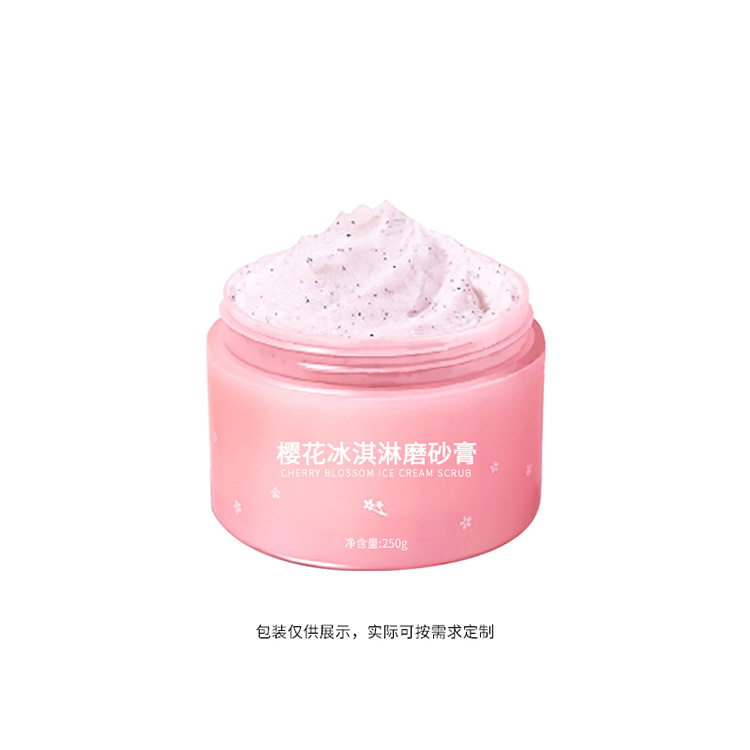
Claims should stay within cosmetic language: gentle exfoliation, smoother texture, brighter appearance. A scrub format that pairs mechanical and enzymatic action is shown in the cherry blossom body scrub listing. Related formulation notes are in the product range, production conditions are described on the workshop page, and project questions can go through contact.
Frequently asked questions
Can you produce Enzyme Exfoliation in Private Label Skincare under our own brand?
Enzyme Exfoliation in Private Label Skincare is handled as a private label project: you bring the brand and the market position, we cover formula, bulk, filling and packing. Existing bases can be adjusted for texture, fragrance and active level, or we develop from a new brief. Tooling and artwork belong to you, and our name does not appear on the pack.
What is the minimum order quantity?
MOQ is set by net fill per unit, not by category:
| Net fill | MOQ |
|---|---|
| < 15 ml/g | 5,000 pcs |
| 15-50 ml/g (50 included) | 3,000 pcs |
| 50-200 ml/g (200 included) | 2,000 pcs |
| > 200 ml/g | 1,000 pcs |
Several SKUs in one project can share a production run to reach the threshold, and a smaller trial order is possible once the formula is approved.
How long do samples and bulk production take?
Samples take 7-10 working days from a confirmed brief, or 10-15 days when a new mould or artwork is involved. Bulk runs 25-35 days after sample approval and packaging arrival. Repeat orders with an unchanged formula usually move faster.
Which certificates and documents come with the shipment?
The plant runs under GMPC and ISO 22716 with a 100,000-class cleanroom. Each shipment can include COA, MSDS, the full INCI list, stability data and microbiological reports. For the EU we support CPSR and PIF paperwork; for other markets we prepare the file set your importer asks for.
Can we change the formula, fragrance or packaging?
Yes. Texture, viscosity, fragrance, colour and active percentage are adjustable within regulatory limits. Packaging can be sourced by you or by us: tubes, airless bottles, jars, sachets and aluminium foil bags, with silkscreen, hot stamping or label application.
What information do you need to quote?
Category and target function, quantity per SKU, packaging direction, destination market and launch date. With that we reply within 24 hours on business days with feasibility, MOQ and a price range. An NDA can be signed before formulas are discussed.
Need this produced? Talk to the factory.
Wangsha Bio has run OEM/ODM production since 2006: 60,000 sqm plant, 17 lines, 100,000-class cleanroom, GMPC and ISO 22716 certified. Send your brief and we reply within 24 hours on business days with feasibility, MOQ and a price range.
Email lucky@moksha-bio.com | Product range | Workshop