Qingyuan moksha Biotechnology Co., Ltd


A toner pad looks like a simple product: a jar, a stack of discs and some liquid. In production it is one of the least forgiving formats in skincare, because three separate decisions have to succeed at the same time and none of them shows its weakness at day one. A pad project fails at the point where substrate, loading and preservation stop agreeing with each other. This guide covers what to settle with a manufacturer before sampling, and which items brand owners most often leave out of the agreement.
Why the Format Is Harder Than It Looks
A pad delivers a liquid through a solid carrier, and the carrier keeps working on the formula after the fill line is finished. It can absorb part of the actives, release fibres into the liquid, swell and change the volume, or hold the liquid so tightly that the user cannot get any out. Every pad project has to be tested as a system, because a formula that passes in a bottle can behave differently inside a stack.
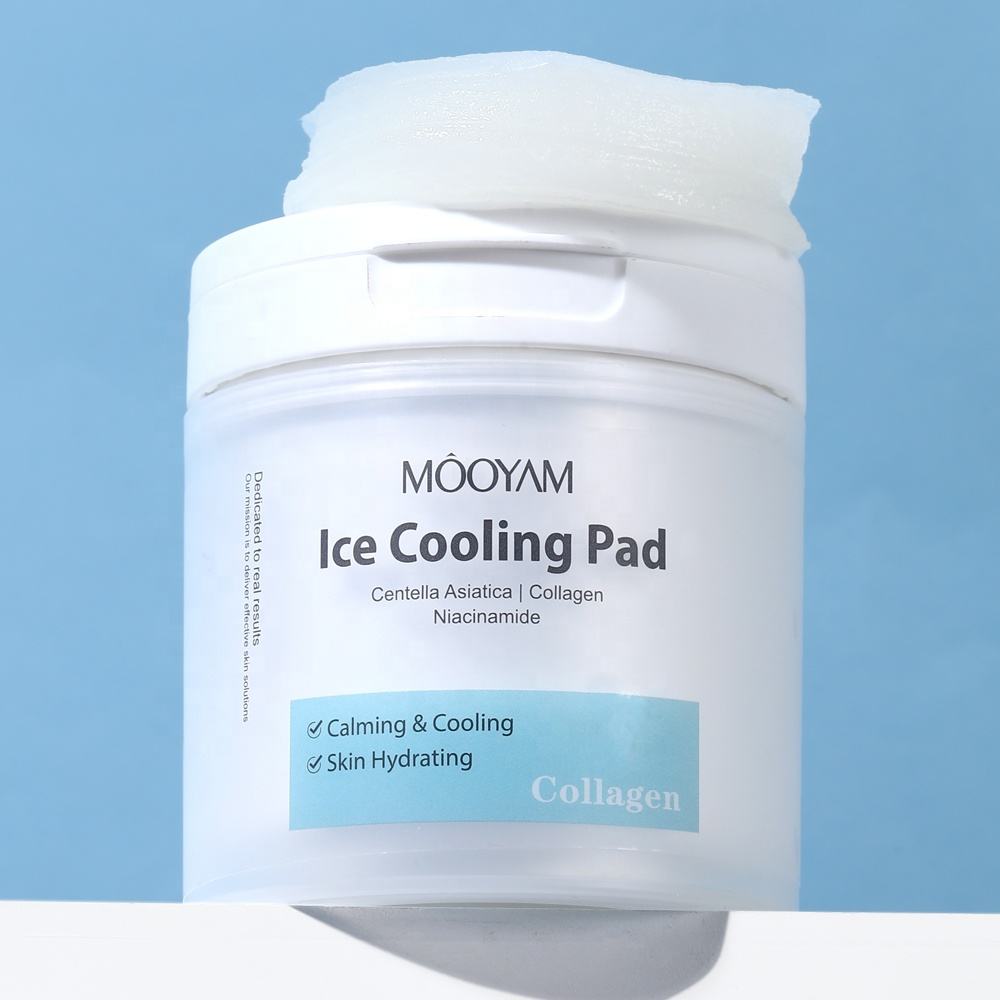
The second reason is exposure. A jar of pads is opened, handled with fingers, resealed and reopened, often in a bathroom. The product is a water-rich, high water activity format with a large opening and repeated contact. Preservation is a load-bearing decision here rather than a line item. Reference formats in the current range include this collagen facial pad.
Substrate Choice and What It Changes
The substrate is usually cotton, rayon, a polyester blend or a textured non-woven. Pure cotton feels soft and holds a lot of liquid, but it can shed fibres and it swells noticeably. Rayon and blends give a cleaner surface and a more predictable thickness. Embossed or grid-textured surfaces add mechanical friction, which matters for a peeling pad and is unnecessary for a plain toner pad. Change the substrate and you have changed the dose the user actually receives.
Thickness, diameter and die-cut shape all interact with the jar. A pad that is even slightly too large for the inner diameter will fan out and dry at the edges. A pad that is too thin collapses when the user takes it out, and the top one in the stack dries first. Pad geometry should be specified together with the jar, not separately.
Liquid loading and saturation control
Loading is normally expressed as a ratio of liquid weight to dry pad weight, and that ratio decides both the sensory result and the economics. Under-loaded pads come out dry and are judged as a poor value; over-loaded pads leave free liquid at the bottom that soaks the bottom discs and can leak in transit. The usable window is narrower than most briefs assume, and it changes with substrate thickness.
Preservation and Compatibility Checks
A wet pad pack combines a high water content, an alkaline or acidic pH depending on the concept, and frequent user contact. Several of the more common preservation options are constrained at low pH, which is exactly where an acid-based peeling pad sits. Settle the pH first and pick the preservation system around it, because the reverse order invalidates the stability work. An acid-toner reference is shown in this AHA toner liquid.
Two compatibility questions should be answered during sampling. The first is adsorption: some actives bind to cellulosic fibre and never reach the skin, so the loaded liquid and the expressed liquid can differ in composition. The second is fibre interaction at low pH, where certain substrates lose wet strength. Ask for an assay of the liquid expressed from the pad, not only of the bulk liquid.
Pack Format, Fill Accuracy and Specifications
Toner pads ship in jars with a sealed inner lid, in refill pouches, or in a rigid flip-top tub. Jars read as a premium format and are easy to reuse, but they offer the least protection. Refill pouches reduce pack cost and shipping weight at the cost of a less convenient first use. Choose the pack against how the product will be stored and handled, because that is what determines the failure mode.
Fill accuracy deserves more attention than it usually receives. A jar is filled by pad count plus liquid weight, and both have tolerances. Net content must hold at the declared count and at the declared liquid weight across the batch. Specify the pad count tolerance and the liquid weight tolerance separately, or a genuine shortfall can be argued to be within specification.
Three items belong in the written specification: the challenge test method and acceptance criteria run on the finished pack, the pH range with an allowable tolerance, and the loading ratio with its permitted variation. Manufacturer capability is described in the workshop overview, credential documentation appears on the about us page, and specification requests can be sent through the inquiry form.
Toner pads sell on convenience and are used in the least controlled environment of any skincare format. Fix the substrate and the jar together, agree the loading ratio, prove the preservation system in the final pack, and write the tolerances into the agreement. Done in that order, a pad project is unglamorous and reliable, which is exactly what a repeat purchase needs.
Frequently asked questions
Can you produce Facial Toner Pad and Peeling Pad OEM under our own brand?
Facial Toner Pad and Peeling Pad OEM is handled as a private label project: you bring the brand and the market position, we cover formula, bulk, filling and packing. Existing bases can be adjusted for texture, fragrance and active level, or we develop from a new brief. Tooling and artwork belong to you, and our name does not appear on the pack.
What is the minimum order quantity?
MOQ is set by net fill per unit, not by category:
| Net fill | MOQ |
|---|---|
| < 15 ml/g | 5,000 pcs |
| 15-50 ml/g (50 included) | 3,000 pcs |
| 50-200 ml/g (200 included) | 2,000 pcs |
| > 200 ml/g | 1,000 pcs |
Several SKUs in one project can share a production run to reach the threshold, and a smaller trial order is possible once the formula is approved.
How long do samples and bulk production take?
Samples take 7-10 working days from a confirmed brief, or 10-15 days when a new mould or artwork is involved. Bulk runs 25-35 days after sample approval and packaging arrival. Repeat orders with an unchanged formula usually move faster.
Which certificates and documents come with the shipment?
The plant runs under GMPC and ISO 22716 with a 100,000-class cleanroom. Each shipment can include COA, MSDS, the full INCI list, stability data and microbiological reports. For the EU we support CPSR and PIF paperwork; for other markets we prepare the file set your importer asks for.
Can we change the formula, fragrance or packaging?
Yes. Texture, viscosity, fragrance, colour and active percentage are adjustable within regulatory limits. Packaging can be sourced by you or by us: tubes, airless bottles, jars, sachets and aluminium foil bags, with silkscreen, hot stamping or label application.
What information do you need to quote?
Category and target function, quantity per SKU, packaging direction, destination market and launch date. With that we reply within 24 hours on business days with feasibility, MOQ and a price range. An NDA can be signed before formulas are discussed.
Need this produced? Talk to the factory.
Wangsha Bio has run OEM/ODM production since 2006: 60,000 sqm plant, 17 lines, 100,000-class cleanroom, GMPC and ISO 22716 certified. Send your brief and we reply within 24 hours on business days with feasibility, MOQ and a price range.
Email lucky@moksha-bio.com | Product range | Workshop