Qingyuan moksha Biotechnology Co., Ltd


Microbiome skin care has been discussed for several seasons, yet at the formula bench the usable raw materials are prebiotics and postbiotics rather than live cultures. The formulation basis for microbiome positioning is feeding or supplying metabolites to the skin surface, not adding bacteria to the product. Understanding that distinction avoids most of the usual mistakes. This article covers material choice, stability risk and claim boundaries.
1. Getting the Vocabulary Right
Probiotics are live organisms and cannot survive in a cosmetic product, because the preservation system is designed to inactivate them. Prebiotics are carbohydrates and polyols that the skin surface can use as a substrate. Postbiotics are metabolites or inactivated cell material. Only the latter two are genuinely available to a formulator, so a claim of live cultures is a reliable sign of loose writing.
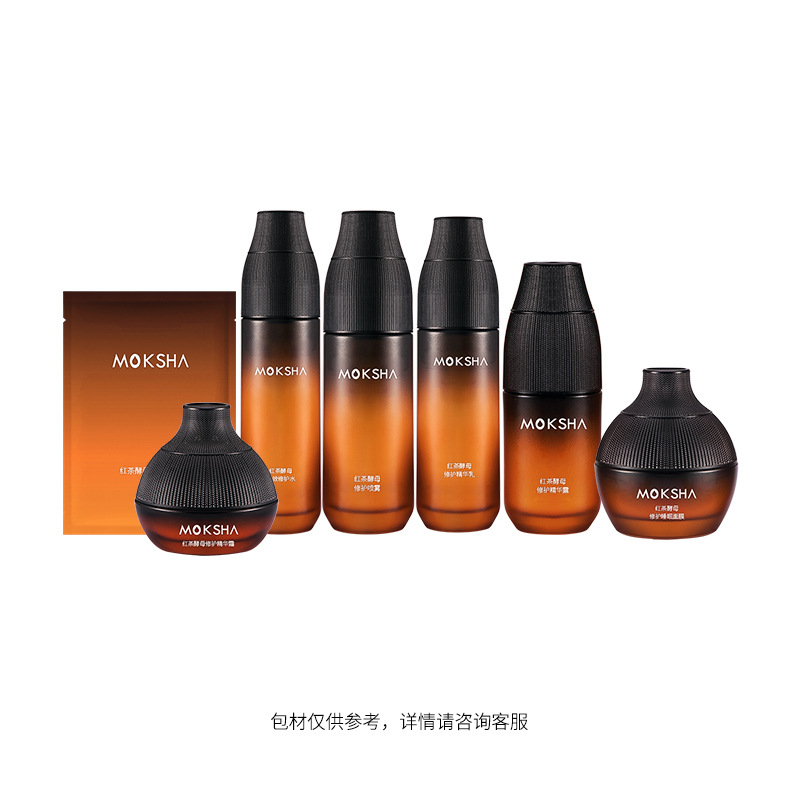
Common prebiotic materials include fructo-oligosaccharides and gluco-oligosaccharides; postbiotic materials include fermented lysates and filtrates. Names sit close together while mechanisms and processing requirements differ, so the material type should be confirmed before a brief is written. Reference formats are shown as a black tea yeast repair set and a fermented soothing cream.
2. Where It Sits in the Formula and How Much to Add
Prebiotics are mostly water-soluble carbohydrates and go into the water phase, where they change viscosity and skin feel, becoming tacky at higher doses. Postbiotic materials are often liquid with meaningful solids content, so odour, colour and preservation compatibility all need checking. Higher dosage is not better; running past the supplier's effective range only adds cost and stability risk.
When paired with a humectant system, prebiotics can be crowded out in sensory terms, which means adjusting thickeners and rheology modifiers. Sensory tuning in this category takes more sampling rounds than most active-led projects.
Dosage also has to be read against the preservation system. Many postbiotic materials arrive with their own pH and ionic load, and shifting the water phase can change how the preservative partitions between phases. Systems built on organic acids are especially sensitive to pH movement, because the active form only exists inside a narrow window. Running a compatibility panel before the dosage is fixed saves a reformulation later.
Batch variation in fermented materials
Fermented raw materials carry natural batch variation in colour, odour and solids content. Development samples should be prepared at the upper and lower specification limits so that variation is understood before scale-up.
3. Two Real Risks: Preservation and Stability
Prebiotics are a food source, so they can also feed microbes if the preservation system is weak. Formulas built on sugar-type prebiotics need a full challenge test rather than inheriting a preservation level from a sister product.
Postbiotic materials often contain proteins and polysaccharides, so prolonged heat can cause precipitation or odour shift. Adding them late in the process with controlled temperature is usually the safer route, and the addition sequence should be confirmed at our workshop during pilot runs.
Checking both risks together is more efficient than sequencing them. A single pilot batch can carry the challenge test and the accelerated stability work in parallel, using the same filling run and the same pack. Handling preservation and stability as one development gate keeps the project timeline realistic instead of stretching it.
4. Claim Boundaries
Skin flora and barrier condition are related, but a cosmetic formula can only speak about comfort and mildness. Any wording implying that a product rebalances flora or improves a skin condition moves outside the cosmetic claim boundary.
Label wording and notification documents are easiest to settle early in development. Our about us page summarises how filing support is handled, and concepts can be raised through the inquiry form.
Microbiome positioning is a real raw-material choice, not an empty concept. Identify the material type accurately, prove the preservation system, and keep claims inside the safe zone, and the category is entirely buildable.
Frequently asked questions
Can you produce Microbiome-Friendly Skincare under our own brand?
Microbiome-Friendly Skincare is handled as a private label project: you bring the brand and the market position, we cover formula, bulk, filling and packing. Existing bases can be adjusted for texture, fragrance and active level, or we develop from a new brief. Tooling and artwork belong to you, and our name does not appear on the pack.
What is the minimum order quantity?
MOQ is set by net fill per unit, not by category:
| Net fill | MOQ |
|---|---|
| < 15 ml/g | 5,000 pcs |
| 15-50 ml/g (50 included) | 3,000 pcs |
| 50-200 ml/g (200 included) | 2,000 pcs |
| > 200 ml/g | 1,000 pcs |
Several SKUs in one project can share a production run to reach the threshold, and a smaller trial order is possible once the formula is approved.
How long do samples and bulk production take?
Samples take 7-10 working days from a confirmed brief, or 10-15 days when a new mould or artwork is involved. Bulk runs 25-35 days after sample approval and packaging arrival. Repeat orders with an unchanged formula usually move faster.
Which certificates and documents come with the shipment?
The plant runs under GMPC and ISO 22716 with a 100,000-class cleanroom. Each shipment can include COA, MSDS, the full INCI list, stability data and microbiological reports. For the EU we support CPSR and PIF paperwork; for other markets we prepare the file set your importer asks for.
Can we change the formula, fragrance or packaging?
Yes. Texture, viscosity, fragrance, colour and active percentage are adjustable within regulatory limits. Packaging can be sourced by you or by us: tubes, airless bottles, jars, sachets and aluminium foil bags, with silkscreen, hot stamping or label application.
What information do you need to quote?
Category and target function, quantity per SKU, packaging direction, destination market and launch date. With that we reply within 24 hours on business days with feasibility, MOQ and a price range. An NDA can be signed before formulas are discussed.
Need this produced? Talk to the factory.
Wangsha Bio has run OEM/ODM production since 2006: 60,000 sqm plant, 17 lines, 100,000-class cleanroom, GMPC and ISO 22716 certified. Send your brief and we reply within 24 hours on business days with feasibility, MOQ and a price range.
Email lucky@moksha-bio.com | Product range | Workshop