Qingyuan moksha Biotechnology Co., Ltd


Niacinamide has become the default active in brightening and oil-control products, and for good reason. It is water soluble, well tolerated by most skin types, compatible with a wide range of bases and inexpensive relative to its marketing value. That combination makes it look like an easy ingredient to formulate with. In practice, niacinamide projects fail for boring reasons: the serum turns yellow in the bottle, the texture turns sticky at higher loading, or the pH drifts during scale-up and the claim no longer matches the label.
Concentration and the pH window
Most commercial products sit between two and five percent. Below two percent the story is hard to support; above five percent the sensory penalty grows faster than the perceived benefit, and the risk of irritation rises for sensitive users.
Niacinamide is stable across a broad pH range, but it hydrolyses to nicotinic acid under prolonged heat or at low pH. Nicotinic acid is the component associated with flushing and stinging, so a formula that starts at pH 4.5 and drifts downward in storage can become uncomfortable over its shelf life.
Target a pH between 5.0 and 6.5 unless another active forces a different window. If the formula includes an acid at low pH, shorten the stability protocol and measure nicotinic acid content rather than only visual colour. Buffer capacity matters more than the initial reading.
Texture and viscosity control
Niacinamide is a small, highly water-soluble molecule with a salting-in effect on some thickeners. Carbomer gels can lose viscosity as the loading increases, while xanthan and gellan hold up better but feel more slippery. A blend of a lightly crosslinked polymer with a gum is often the practical answer.
Humectant load drives the sticky sensation. Glycerin above roughly eight percent gives a tacky afterfeel in a watery serum; butylene glycol and propanediol spread more cleanly. Match the humectant system to the climate of the target market, because a texture that feels comfortable in a humid city can feel heavy in a dry one.
If the brief calls for a watery, fast-absorbing serum, keep the polymer level low and accept a shorter shelf stability window, or move to a packaging format that limits air contact. If the brief calls for a cushiony gel, the trade-off is a longer dry-down.
Pairing with other actives
Niacinamide pairs well with hyaluronic acid, panthenol, zinc PCA and most peptides. It is less comfortable with strong acids at low pH, where the combination can sting, and with high levels of reducing agents that may affect colour over time.
Vitamin C is the pairing that generates the most questions. The two can coexist, but the pH requirements pull in opposite directions and the colour stability of an ascorbic acid system is usually the limiting factor. If both actives are required, consider a dual-chamber pack or separate AM and PM products rather than forcing them into one bottle.
With exfoliating acids, the practical limit is sensory rather than chemical. A low-pH leave-on product already carries a sting risk; adding a high niacinamide load multiplies it.
Colour, odour and stability
Yellowing is the classic niacinamide complaint. It usually comes from trace metal ions, light exposure or heat during processing, and it accelerates in clear packaging. Chelating agents help, as does a opaque or amber pack.
Raw material quality is a variable that buyers underestimate. Nicotinic acid content in the incoming niacinamide, and the presence of iron, both influence the final colour. Set an incoming specification for nicotinic acid and metals, not only for assay.
Odour is subtler. Some grades carry an amine note that becomes noticeable at higher loading or after warming. A trained panel at the bulk stage catches this before filling.
Scaling from lab batch to bulk
Niacinamide dissolves easily, which encourages fast processing. That is exactly where problems start. Adding it at too high a temperature, or holding the bulk hot while waiting for the filling line, drives hydrolysis and colour change.
A practical process adds niacinamide after the main phase has cooled to around 45 to 50 degrees Celsius, with adequate mixing and a short hold time. Cap the time the bulk spends above 60 degrees, and record it in the batch record so deviations are visible.
pH adjustment should happen after all actives are in, and the reading should be taken at the same temperature each time. A drift of a few tenths between lab and production is normal; a drift of a full unit usually means the buffer system is too weak.
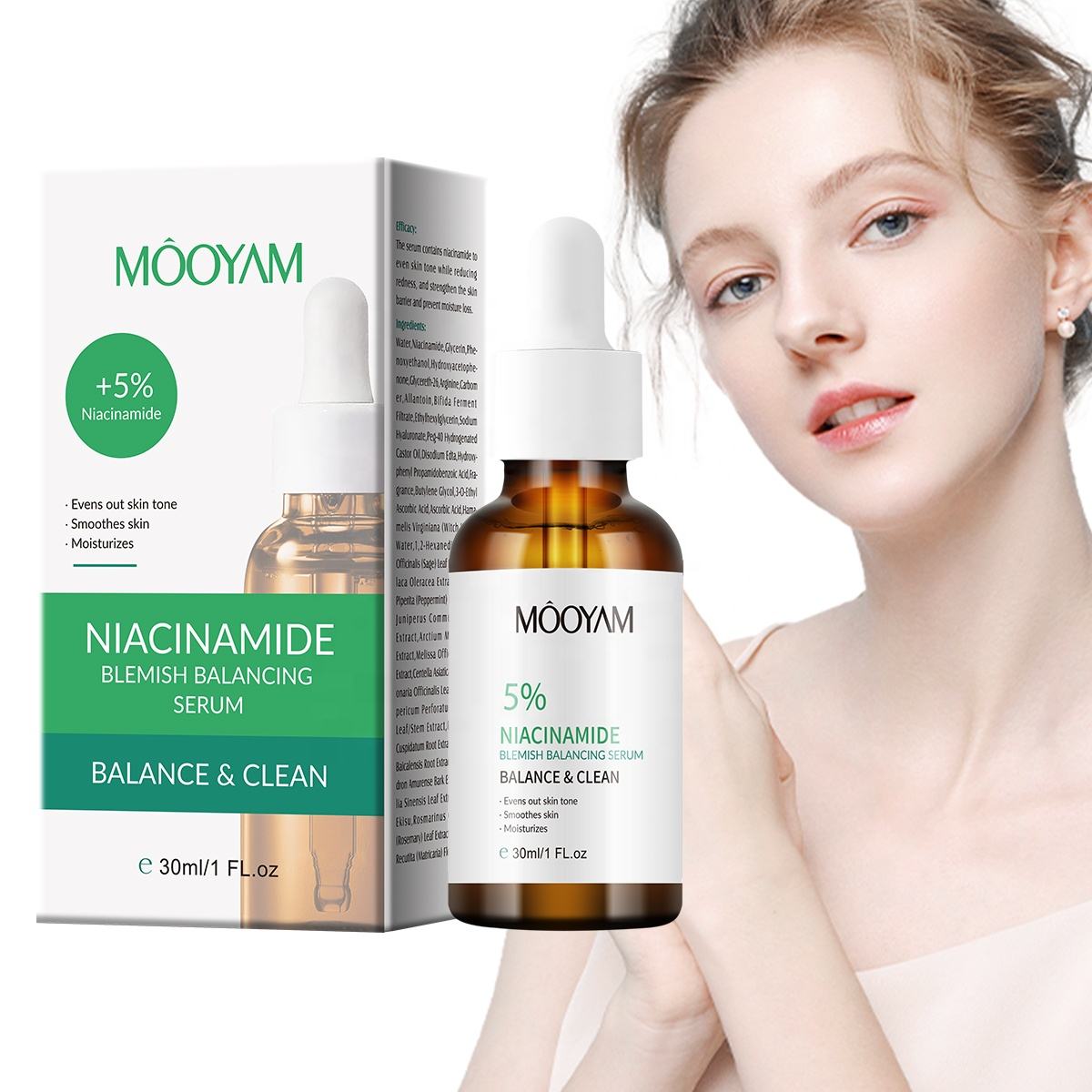
Our niacinamide serum reference shows a typical five percent format, and the workshop overview covers bulk handling and filling. Briefs can be sent through the inquiry form, and the wider product range shows how the active is used across formats.
Niacinamide rewards discipline more than creativity. Control the pH, the metals and the heat, and the formula will behave.
Frequently asked questions
Can you produce Niacinamide Formulation at Scale under our own brand?
Niacinamide Formulation at Scale is handled as a private label project: you bring the brand and the market position, we cover formula, bulk, filling and packing. Existing bases can be adjusted for texture, fragrance and active level, or we develop from a new brief. Tooling and artwork belong to you, and our name does not appear on the pack.
What is the minimum order quantity?
MOQ is set by net fill per unit, not by category:
| Net fill | MOQ |
|---|---|
| < 15 ml/g | 5,000 pcs |
| 15-50 ml/g (50 included) | 3,000 pcs |
| 50-200 ml/g (200 included) | 2,000 pcs |
| > 200 ml/g | 1,000 pcs |
Several SKUs in one project can share a production run to reach the threshold, and a smaller trial order is possible once the formula is approved.
How long do samples and bulk production take?
Samples take 7-10 working days from a confirmed brief, or 10-15 days when a new mould or artwork is involved. Bulk runs 25-35 days after sample approval and packaging arrival. Repeat orders with an unchanged formula usually move faster.
Which certificates and documents come with the shipment?
The plant runs under GMPC and ISO 22716 with a 100,000-class cleanroom. Each shipment can include COA, MSDS, the full INCI list, stability data and microbiological reports. For the EU we support CPSR and PIF paperwork; for other markets we prepare the file set your importer asks for.
Can we change the formula, fragrance or packaging?
Yes. Texture, viscosity, fragrance, colour and active percentage are adjustable within regulatory limits. Packaging can be sourced by you or by us: tubes, airless bottles, jars, sachets and aluminium foil bags, with silkscreen, hot stamping or label application.
What information do you need to quote?
Category and target function, quantity per SKU, packaging direction, destination market and launch date. With that we reply within 24 hours on business days with feasibility, MOQ and a price range. An NDA can be signed before formulas are discussed.
Need this produced? Talk to the factory.
Wangsha Bio has run OEM/ODM production since 2006: 60,000 sqm plant, 17 lines, 100,000-class cleanroom, GMPC and ISO 22716 certified. Send your brief and we reply within 24 hours on business days with feasibility, MOQ and a price range.
Email lucky@moksha-bio.com | Product range | Workshop