Qingyuan moksha Biotechnology Co., Ltd


Shower gel is one of the hardest categories to differentiate on a shelf, because the base formula is broadly the same across brands. What a shopper can actually see is whatever sits inside the bottle. Pearls, petals and coloured capsules have become the standard answer, and they are routinely treated as an additive rather than as a design problem. The difficulty is not making the particles visible, it is keeping them evenly distributed after three months on a humid shelf. This guide covers particle physics, suspension structure and the checks that decide whether the product survives.
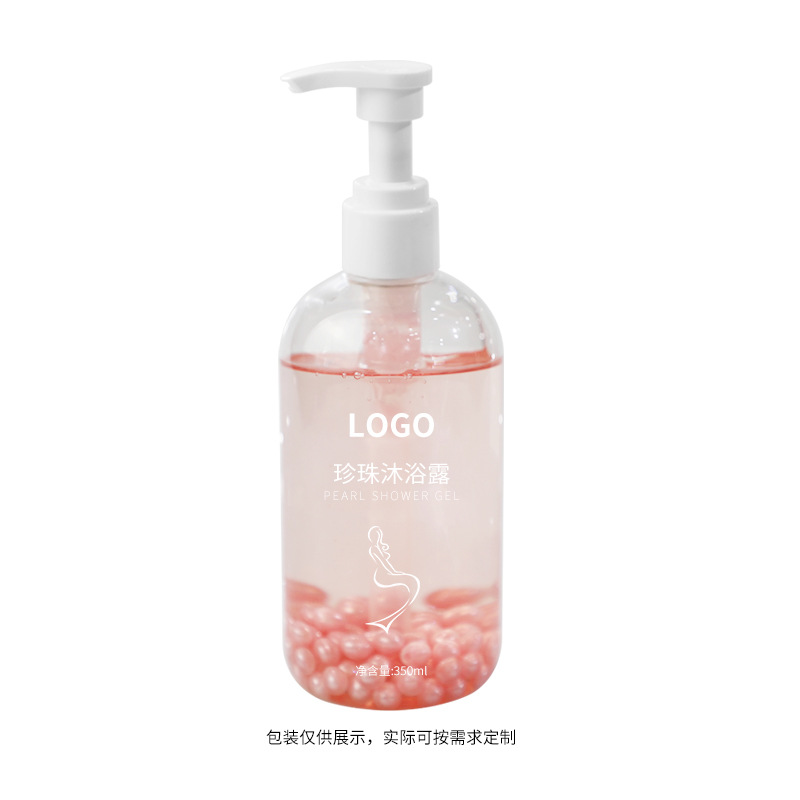
What Visible Particles Actually Buy a Brand
Given comparable cleansing and fragrance, a bottle with suspended particles is picked up more often. The reasoning behind that is simple: something inside the bottle reads as something inside the formula. Pearls suggest nourishment, petals suggest botanical origin, capsules suggest technology. Visible particles translate formulation language into a signal a shopper can read in one glance.
The trade-off is a much tighter consistency requirement. Uneven distribution, a pump that cannot pass the particles, or settling over time turns the selling point into a complaint. Decorative particles are judged on appearance consistency, functional capsules on intact-shell rate, and those are two different acceptance criteria. Existing formats are listed in the product range.
Three Particle Types and How They Differ
Suspended materials fall into three groups: synthetic pearlescent powder, botanical petals, and capsules carrying an active. Pearlescent powder has a small particle size and a density close to the water phase, so it suspends easily but tends to leave colour bands once it settles. Petals are lighter than the base and rise to the shoulder of the bottle. Capsules sit between the two and are the most sensitive to shear damage. Measure density and size distribution before writing the base formula, or every later adjustment will cancel out an earlier one.
Density matching comes first
The density difference between particle and continuous phase decides whether it sinks or rises. Raising the density of the water phase with polyols or sugars slows migration considerably, but it also changes skin feel, and a shower gel has to rinse clean without a slippery residue. Keeping the density difference small works better than raising viscosity, and it costs less in sensory terms. A pearl capsule format is shown in this pearl shower gel reference.
Suspension Structure: Yield Stress Beats Viscosity
Most suspension failures come from trying to solve a yield-stress problem with viscosity. A thick base flows slowly, but that does not mean it holds a particle at rest. What keeps a particle in place is the yield stress of the network, and the particle weight has to sit below that threshold. This matters most in a low-viscosity gel, where salt thickening alone will never produce stable suspension.
Two structures are used in practice. The first is a rheology modifier that builds a network, providing yield stress at rest and thinning quickly under shear. The second is a crystalline or lamellar structure that holds particles through ordered layers. The network route tolerates a wider particle range; the lamellar route gives a clearer gel. Transparent packs push you toward clarity, opaque packs let you trade clarity for stability. Homogenisation and deaeration conditions are described in the workshop overview.
Stability Checks and Filling Control
Stability work on a suspended product is not only about separation. The observation list should include particle accumulation at the base, rising and clustering at the shoulder, colour banding, and cloudiness caused by broken capsules. Write the observation list and acceptance criteria during sampling, because after scale-up there is no shared language to argue with.
Filling affects the result as much as the formula. Agitation that is too strong breaks capsules; agitation that is too weak leaves the tank stratified, so the first bottles and the last bottles carry visibly different particle counts. Slow recirculation with timed sampling is the cheapest way to keep a batch internally consistent. A petal-based format is shown in this fragrance petal shower gel reference, where particle density and base ratio have to be calibrated together.
Cost, Regulation and Claim Boundaries
Visual particles add cost at three points: the particle itself, the higher rheology modifier load, and a slower filling rate. The question for a brand owner is how much premium the effect can carry. Convert the particle cost into an increment per bottle and compare it with the expected retail price, not with the raw material price per kilogram.
On regulation, some synthetic particles are restricted or voluntarily phased out in several markets for environmental reasons, and any export project needs each destination checked before the formula is fixed. Botanical petals bring pesticide residue and microbiological limits at receipt, and a natural origin claim does not reduce the incoming specification. Wording about the particles should stay on appearance, and should never imply a physiological effect. Requirements can be submitted through the inquiry form.
A well-executed suspension looks effortless: even particles, a steady pump, and the same appearance at the end of shelf life as on the first day. Match the density difference, set the yield stress, and pace the filling line, and the effect holds for the whole shelf life rather than the first month.
Frequently asked questions
Can you produce Suspended Visual Particles in Shower Gel under our own brand?
Suspended Visual Particles in Shower Gel is handled as a private label project: you bring the brand and the market position, we cover formula, bulk, filling and packing. Existing bases can be adjusted for texture, fragrance and active level, or we develop from a new brief. Tooling and artwork belong to you, and our name does not appear on the pack.
What is the minimum order quantity?
MOQ is set by net fill per unit: under 15 ml/g 5,000 pcs; 15-50 ml/g 3,000 pcs; 50-200 ml/g 2,000 pcs; above 200 ml/g 1,000 pcs. Several SKUs in one project can share a production run to reach the threshold.
How long do samples and bulk production take?
Samples take 7-10 working days from a confirmed brief, or 10-15 days when a new mould or artwork is involved. Bulk runs 25-35 days after sample approval and packaging arrival. Repeat orders with an unchanged formula usually move faster.
Which certificates and documents come with the shipment?
The plant runs under GMPC and ISO 22716 with a 100,000-class cleanroom. Each shipment can include COA, MSDS, the full INCI list, stability data and microbiological reports. For the EU we support CPSR and PIF paperwork; for other markets we prepare the file set your importer asks for.
Can we change the formula, fragrance or packaging?
Yes. Texture, viscosity, fragrance, colour and active percentage are adjustable within regulatory limits. Packaging can be sourced by you or by us: tubes, airless bottles, jars, sachets and aluminium foil bags, with silkscreen, hot stamping or label application.
What information do you need to quote?
Category and target function, quantity per SKU, packaging direction, destination market and launch date. With that we reply within 24 hours on business days with feasibility, MOQ and a price range. An NDA can be signed before formulas are discussed.
Need this produced? Talk to the factory.
Wangsha Bio has run OEM/ODM production since 2006: 60,000 sqm plant, 17 lines, 100,000-class cleanroom, GMPC and ISO 22716 certified. Send your brief and we reply within 24 hours on business days with feasibility, MOQ and a price range.
Email lucky@moksha-bio.com | Product range | Workshop