Qingyuan moksha Biotechnology Co., Ltd


Every cosmetic pack carries two clocks. One measures the product before it is opened, the other measures it in someone bathroom. They are supported by different evidence and they are routinely confused with each other. Get either one wrong and a product either changes colour at the end of its shelf life or is used long after it should have been discarded. This guide separates the two and covers how each is set.
Two Clocks, Two Logics
Shelf life describes the usable period of an unopened unit stored as directed, and it rests on stability data plus packaging compatibility. Period after opening describes how long a unit stays usable in the consumer hands, and it rests on contamination risk during use and on how tolerant the formula is. The same formula can carry a PAO twice as long in a sealed pump as in an open jar.
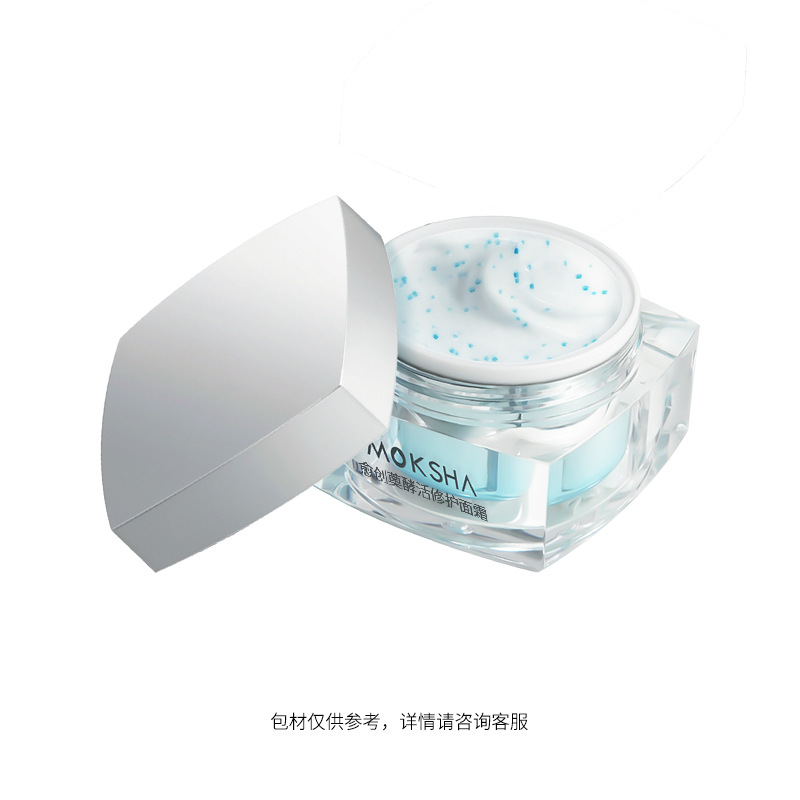
Brand owners often raise shelf life at the start of a project and only think about PAO when the artwork is being prepared. By then the pack is fixed and the formula is closed. PAO belongs in packaging selection, not in the artwork stage. Both pack types coexist in categories such as this barrier repair cream.
Supporting Shelf Life With Stability Data
The standard approach runs accelerated and real-time studies in parallel. Accelerated conditions compress time through heat and light and give a projection; real-time storage confirms whether the projection holds. Accelerated data shows a trend and cannot stand alone as the basis for a shelf life claim.
Observation should cover physical, chemical and microbiological behaviour: separation, colour and odour drift, pH movement, preservative depletion, and challenge test outcome. Formulas built on botanical or oxidation-prone inputs usually fail on colour and odour first. Quantify the acceptable colour and odour range in advance, or acceptance turns into an argument about what the sample used to look like.
Packaging is a variable, not a container
Stability work has to run in the final pack, because a glass jar result does not represent a plastic tube. Oxygen and light transmission, interaction between product and pack, and pump sealing all change the outcome. Changing the pack is equivalent to changing the product, and the stability programme has to be repeated.
How PAO Is Judged
PAO depends mainly on how fast contamination and deactivation occur after opening. An open jar used with fingers carries higher risk and usually gets a shorter period; a sealed pump that never exposes the bulk carries lower risk and can be given longer. How the product is taken out is the first variable and the formula is only the second.
Two approaches work in practice. One is a simulated use study that opens, dispenses and closes at a realistic frequency, with microbiological and sensory checks at set points. The other is to follow category convention, but that has to be justified with the specific differences. Following a competitor is not evidence, and it does not survive a challenge. Cleanroom and filling conditions are described in the workshop overview.
Declaration and Common Mistakes
PAO is normally shown as an open-jar symbol with a month count, while shelf life appears as a production date plus a use-by date. Both have rules on placement and form that cannot be bent for layout reasons. Reserve space for mandatory information first and design the visual around it, not the reverse.
Three mistakes recur: treating PAO as an extension of shelf life, pairing a declared shelf life with vague wording such as use promptly after opening, and inconsistent figures between batches. Vague wording feels safe and becomes evidence against the brand in a complaint.
Writing Both Into the Project File
The specification should fix four things: the basis and test conditions behind the shelf life, the basis and simulated-use method behind the PAO, the revalidation trigger when packaging changes, and who is responsible for the declaration. With those four written down, a pack change or a formula tweak immediately shows whether new testing is needed.
Both clocks are design parameters rather than conclusions handed down by the factory. A shorter period buys a faster launch with less testing; a longer one demands a fuller data set. Shelf life and PAO are a choice between cost and risk, and the choice belongs to the brand. Manufacturer credentials appear on the about us page, and projects can be discussed through the contact page.
Two dates on a pack look trivial and rest on a complete chain of evidence. Decide them together with the pack and the use habit, and they hold up when someone asks how they were derived.
Frequently asked questions
Can you produce Shelf Life and Period After Opening under our own brand?
Shelf Life and Period After Opening is handled as a private label project: you bring the brand and the market position, we cover formula, bulk, filling and packing. Existing bases can be adjusted for texture, fragrance and active level, or we develop from a new brief. Tooling and artwork belong to you, and our name does not appear on the pack.
What is the minimum order quantity?
MOQ is set by net fill per unit: under 15 ml/g 5,000 pcs; 15-50 ml/g 3,000 pcs; 50-200 ml/g 2,000 pcs; above 200 ml/g 1,000 pcs. Several SKUs in one project can share a production run to reach the threshold.
How long do samples and bulk production take?
Samples take 7-10 working days from a confirmed brief, or 10-15 days when a new mould or artwork is involved. Bulk runs 25-35 days after sample approval and packaging arrival. Repeat orders with an unchanged formula usually move faster.
Which certificates and documents come with the shipment?
The plant runs under GMPC and ISO 22716 with a 100,000-class cleanroom. Each shipment can include COA, MSDS, the full INCI list, stability data and microbiological reports. For the EU we support CPSR and PIF paperwork; for other markets we prepare the file set your importer asks for.
Can we change the formula, fragrance or packaging?
Yes. Texture, viscosity, fragrance, colour and active percentage are adjustable within regulatory limits. Packaging can be sourced by you or by us: tubes, airless bottles, jars, sachets and aluminium foil bags, with silkscreen, hot stamping or label application.
What information do you need to quote?
Category and target function, quantity per SKU, packaging direction, destination market and launch date. With that we reply within 24 hours on business days with feasibility, MOQ and a price range. An NDA can be signed before formulas are discussed.
Need this produced? Talk to the factory.
Wangsha Bio has run OEM/ODM production since 2006: 60,000 sqm plant, 17 lines, 100,000-class cleanroom, GMPC and ISO 22716 certified. Send your brief and we reply within 24 hours on business days with feasibility, MOQ and a price range.
Email lucky@moksha-bio.com | Product range | Workshop