Qingyuan moksha Biotechnology Co., Ltd


Peel-off masks occupy a fun corner of the mask category: part skincare, part experience. Consumers love the satisfaction of peeling off a whole film, and social platforms keep the format visible. For private label buyers, though, peel-off is also one of the trickier formats to get right, because the entire experience depends on film-forming chemistry and drying behaviour. A peel-off mask that peels badly is a one-time purchase; one that peels cleanly builds a repeat line. This article breaks the format down for buyers.
How the Film Forms
The classic peel-off base is polyvinyl alcohol, often blended with other film formers to adjust flexibility and drying speed. As water and alcohol evaporate after application, the dissolved polymers coalesce into a continuous film that lifts sebum, dead surface cells and impurities when removed. The film former system decides everything: drying time, peel integrity, and how much residue stays behind.
PVA levels typically range from 8% to 15% in finished formulas. Higher levels give stronger films but longer drying times and a tighter, sometimes uncomfortable feel. There is a comfort window where the film is strong enough to peel in one piece yet loose enough not to pull uncomfortably; hitting it requires blending, not just more PVA.
Removal Experience Is the Product
Users judge peel-off masks by three moments: how it applies, how it dries, and how it comes off. Application should be an even, non-dripping layer; drying should finish within a predictable window; removal should come off in one or two large pieces without painful tugging. Each moment can be tuned: humectants slow drying, plasticisers soften the film, and flexibility additives prevent cracking mid-peel.
Common failure modes buyers should test for: the film cracks into fragments, leaves grey residue at the edges, or re-wets and smears when touched. All three trace back to the polymer ratio and the drying conditions used during sampling. Insist on finger-test panels during sampling, not just lab data; real peeling behaviour shows up on skin, not on glass plates.
Pairing Actives with the Format
Peel-off masks carry functional stories well: charcoal and clays for oil-absorbing positioning, fruit extracts for a brightened-look angle, and cooling agents for after-sun freshness. Rice extract, used in several current stock formulas, gives a gentle brightening-look story. Choose actives that survive the drying phase and stay compatible with the polymer system; volatile or delicate actives waste their dosage in this format.
Because the product is rinse-free and removed physically, claims around visible pore-cleansing and smoothness are common. Keep them cosmetic and observation-based. The physical removal action is the demonstrable benefit; write claims around what users can see, not what the film supposedly does invisibly.
Filling, Packaging and Texture Control
Peel-off masks are usually filled into tubes or jars with a relatively fluid gel texture. Viscosity matters for both application control and settling: too thin and it runs toward eyes and mouth; too thick and users apply a patchy layer. Fill viscosity should be validated across the storage temperature range, since winter cold can turn a fluid gel into a paste.
Alcohol-containing versions need tighter sealing and volatile-loss testing on the package. Tubes with narrow nozzles give the cleanest application. Package and formula must be developed together here more than in almost any other mask format. Production line capabilities can be checked on the workshop page.
Positioning and Buyer Checklist
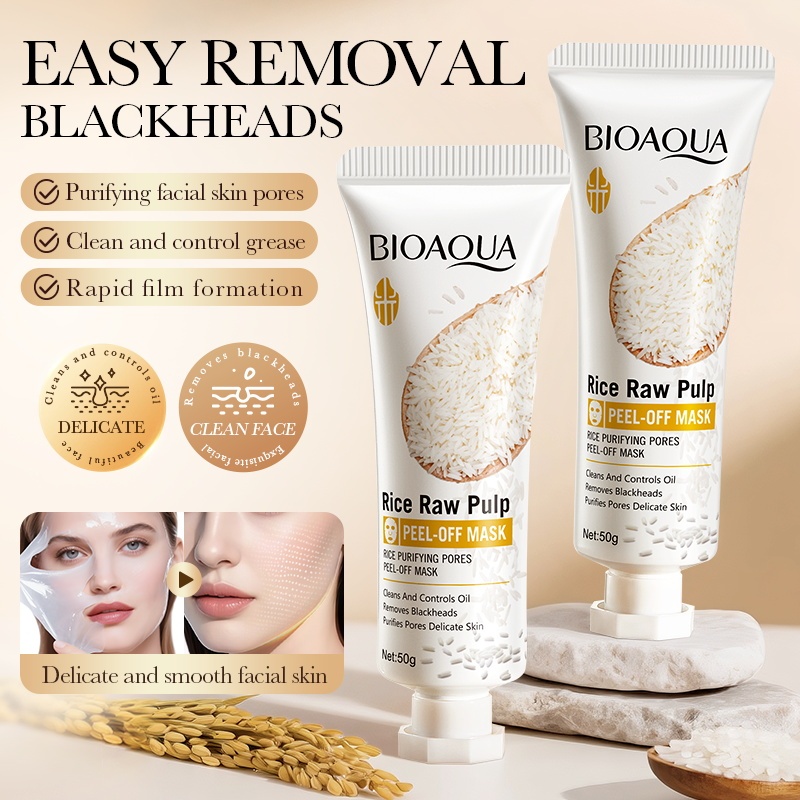
Peel-off works well as a complementary item in a mask line: a charcoal version for oily skin, a rice or botanical version for gentle weekly care, and a cooling version for summer promotions. A ready stock example is the BIOAQUA rice extract peel-off mask on the product page. Position peel-off as the fun, high-visibility item in the line, and let sheet masks carry the daily-care story.
Buyers should ask for: drying time on skin, peel integrity scores from test panels, viscosity profile, and package compatibility data. Sampling and formula customisation can start through the inquiry page, and the full mask range is listed in the product catalogue. Questions about compliance documentation go through the contact page.
In summary, peel-off masks live or die on film chemistry and removal feel. Sample with real panels, tune the polymer system to the comfort window, keep claims visible and honest, and the format pays back with strong shelf presence.
Frequently asked questions
Can you produce Peel-Off Masks under our own brand?
Peel-Off Masks is handled as a private label project: you bring the brand and the market position, we cover formula, bulk, filling and packing. Existing bases can be adjusted for texture, fragrance and active level, or we develop from a new brief. Tooling and artwork belong to you, and our name does not appear on the pack.
What is the minimum order quantity?
MOQ is set by net fill per unit: under 15 ml/g 5,000 pcs; 15-50 ml/g 3,000 pcs; 50-200 ml/g 2,000 pcs; above 200 ml/g 1,000 pcs. Several SKUs in one project can share a production run to reach the threshold.
How long do samples and bulk production take?
Samples take 7-10 working days from a confirmed brief, or 10-15 days when a new mould or artwork is involved. Bulk runs 25-35 days after sample approval and packaging arrival. Repeat orders with an unchanged formula usually move faster.
Which certificates and documents come with the shipment?
The plant runs under GMPC and ISO 22716 with a 100,000-class cleanroom. Each shipment can include COA, MSDS, the full INCI list, stability data and microbiological reports. For the EU we support CPSR and PIF paperwork; for other markets we prepare the file set your importer asks for.
Can we change the formula, fragrance or packaging?
Yes. Texture, viscosity, fragrance, colour and active percentage are adjustable within regulatory limits. Packaging can be sourced by you or by us: tubes, airless bottles, jars, sachets and aluminium foil bags, with silkscreen, hot stamping or label application.
What information do you need to quote?
Category and target function, quantity per SKU, packaging direction, destination market and launch date. With that we reply within 24 hours on business days with feasibility, MOQ and a price range. An NDA can be signed before formulas are discussed.
Need this produced? Talk to the factory.
Wangsha Bio has run OEM/ODM production since 2006: 60,000 sqm plant, 17 lines, 100,000-class cleanroom, GMPC and ISO 22716 certified. Send your brief and we reply within 24 hours on business days with feasibility, MOQ and a price range.
Email lucky@moksha-bio.com | Product range | Workshop