Qingyuan moksha Biotechnology Co., Ltd


Face removers and eye-lip removers solve different problems. A cleansing balm or oil handles full-face base makeup with a robust surfactant load, while the eye area needs to dissolve waterproof mascara and long-wear lipstick on the thinnest skin of the face, close to the eye itself and on lips that may touch food. The whole discipline of an eye and lip remover is balancing two opposing demands: enough solvency to lift a waterproof film, and enough mildness that accidental eye contact never becomes a complaint.
Why Eyes and Lips Need Their Own Remover
Face cleansing products rely on stronger surfactants or higher oil phases that sting when they migrate into the eye and leave an unpleasant taste scenario on lips. A dedicated eye-lip formula uses mild surfactant classes, a restrained oil phase and no alcohol, no added fragrance and a gentle preservative set. Dedicated formulas solve the sensitive-location problem, and brands that let customers improvise with face removers usually collect stinging reviews.
Commercially the SKU earns its place: it empties fast, repurchases frequently and bundles naturally with the rest of the makeup-removal line. A remover range without an eye-lip SKU reads incomplete to informed buyers.
Gentle Systems, pH and Osmolality
Mildness in this category is engineered on three levels. Surfactant selection favours amino-acid-based and nonionic classes over soap systems. The formula pH is steered close to neutral and buffered, and osmolality is adjusted toward the tear environment so accidental contact feels like water rather than a chemical event. No-sting is not a subtraction exercise; surfactant class, pH and osmolality must all land in the right window together.
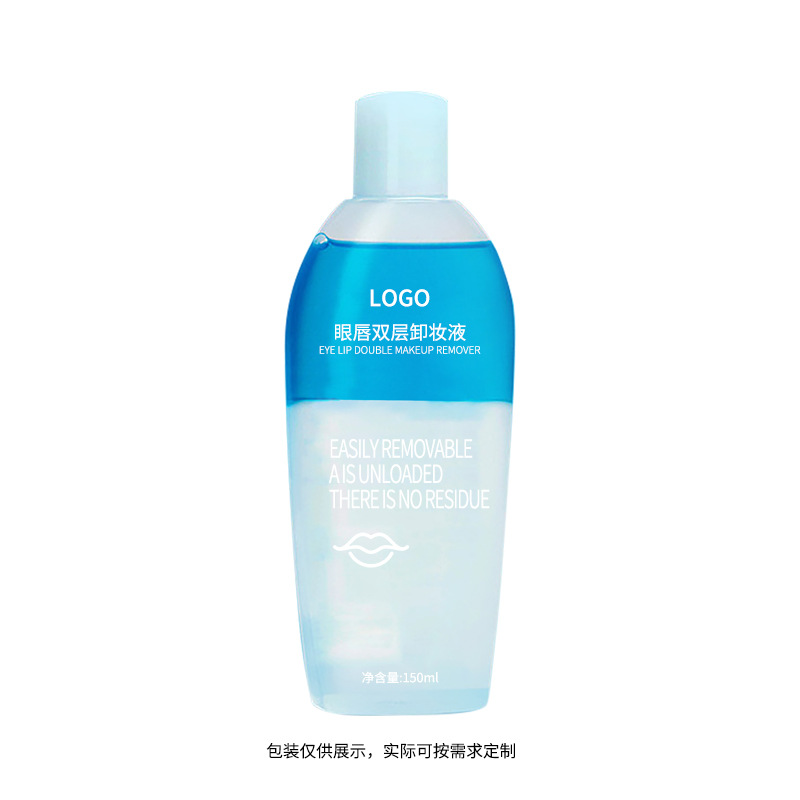
Structure choice follows the target market. A bi-phase bottle needs shaking: the upper oil layer dissolves the waterproof film in one pass and suits heavy makeup markets, while a single-phase water system relies on solubilisation and suits daily light makeup. Choose the structure by the makeup habits of the market, not by the prettier bottle. A bi-phase reference product sits on the product page, and the wider remover range is listed in the product section.
Lifting Waterproof Films Without Residue
Waterproof mascara and matte lipsticks anchor themselves with film formers, and ordinary water systems barely move them. Removal performance depends on the oil fraction, the solubilisation capacity and how fast the shaken mixture emulsifies on contact. Run sampling tests against the bestselling waterproof products of the target market, because standard swatch plates hide exactly the failures customers will report.
The after-rinse feel is the second invisible line. Too much oil leaves a hazy film over the eye area; too strong a surfactant leaves dryness. The workable middle path keeps the oil fraction modest and adds small amounts of water-soluble emollients. Dissolves cleanly, rinses away completely, no haze afterwards: when a sample passes those three checks the experience is settled.
Safety Evidence Buyers Should Ask For
Eye-area claims rest on irritation data. Animal testing has been replaced in most markets by in-vitro alternatives combined with human patch studies, covering both single accidental contact and repeated intended use. Positioning language about eye-level safety must be backed by a documented irritation package, not by wording alone.
Two further checks sharpen the file: a rinse-off residue assessment confirming no film lingers around the eye, and compatibility checks with contact-lens wearers, a frequent user question. In this category the irritation dossier carries more weight than any efficacy claim. Facility and testing arrangements are summarised on the workshop page.
Pack Formats and Buyer Advice
Bi-phase bottles need a shake well before use, so the label must instruct it clearly, and the two layers should separate visually clean after standing. Pump heads and squeezy nozzles with a defined orifice help the user aim onto a cotton pad, and filling accuracy keeps the dose predictable. Let the usage gesture decide the pack, and validate layer separation and shake-recovery on accelerated storage. Sampling runs through the contact page, an RFQ form is on the Inquiry page, and company background is on the about us page.
Frequently asked questions
Can you produce Eye and Lip Makeup Removers under our own brand?
Eye and Lip Makeup Removers is handled as a private label project: you bring the brand and the market position, we cover formula, bulk, filling and packing. Existing bases can be adjusted for texture, fragrance and active level, or we develop from a new brief. Tooling and artwork belong to you, and our name does not appear on the pack.
What is the minimum order quantity?
MOQ is set by net fill per unit: under 15 ml/g 5,000 pcs; 15-50 ml/g 3,000 pcs; 50-200 ml/g 2,000 pcs; above 200 ml/g 1,000 pcs. Several SKUs in one project can share a production run to reach the threshold.
How long do samples and bulk production take?
Samples take 7-10 working days from a confirmed brief, or 10-15 days when a new mould or artwork is involved. Bulk runs 25-35 days after sample approval and packaging arrival. Repeat orders with an unchanged formula usually move faster.
Which certificates and documents come with the shipment?
The plant runs under GMPC and ISO 22716 with a 100,000-class cleanroom. Each shipment can include COA, MSDS, the full INCI list, stability data and microbiological reports. For the EU we support CPSR and PIF paperwork; for other markets we prepare the file set your importer asks for.
Can we change the formula, fragrance or packaging?
Yes. Texture, viscosity, fragrance, colour and active percentage are adjustable within regulatory limits. Packaging can be sourced by you or by us: tubes, airless bottles, jars, sachets and aluminium foil bags, with silkscreen, hot stamping or label application.
What information do you need to quote?
Category and target function, quantity per SKU, packaging direction, destination market and launch date. With that we reply within 24 hours on business days with feasibility, MOQ and a price range. An NDA can be signed before formulas are discussed.
Need this produced? Talk to the factory.
Wangsha Bio has run OEM/ODM production since 2006: 60,000 sqm plant, 17 lines, 100,000-class cleanroom, GMPC and ISO 22716 certified. Send your brief and we reply within 24 hours on business days with feasibility, MOQ and a price range.
Email lucky@moksha-bio.com | Product range | Workshop