Qingyuan moksha Biotechnology Co., Ltd


Every few years a new pair of actives takes over the anti-ageing conversation, and the current wave belongs to NAD+ precursors and sodium DNA, the family that includes the salmon-derived materials already familiar from professional channels. Marketplaces list complete sets built around them, and consumers arrive pre-educated by short video content. For private label buyers the question is not whether these names sell, but whether the product behind the name survives formulation, stability and regulatory scrutiny.
What These Actives Actually Are
NAD+-related actives address the cellular energy story: the molecule and its precursors are associated with metabolic pathways that decline with age, which is why the ingredient carries such a strong narrative. Sodium DNA, typically sourced from fish-derived material, belongs to the regenerative-support family and is chemically a high-molecular-weight polynucleotide. Both actives sell a biological story, so both need sourcing quality and documentation that match the story.
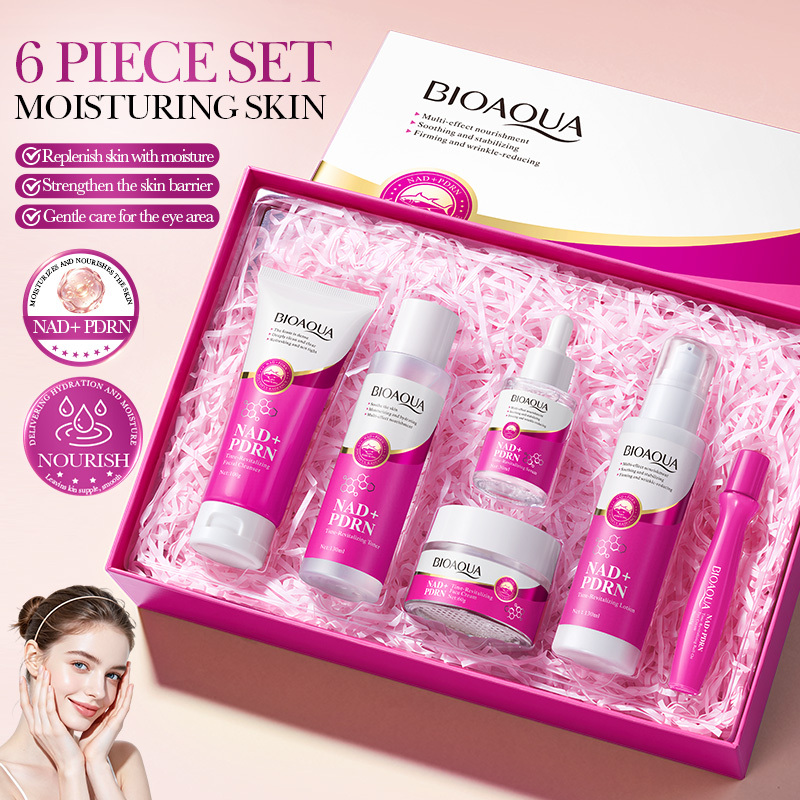
Grades matter enormously. Fish-source sodium DNA varies by extraction purity and molecular weight distribution, and NAD+ precursors vary by salt form and stability. Ask for the specification sheet, the source documentation and the stability data before the price conversation, because grade differences rewrite the formulation. A set built around these actives is shown on the product page, and comparable ranges sit in the product section.
Formulation Challenges to Expect
Polynucleotide materials are high-molecular-weight and water-loving, which shapes the base: they suit aqueous serum and essence formats and resist integration into anhydrous or high-oil systems. Molecular weight also limits passive penetration, so honest positioning talks about surface-level support and hydration rather than deep-tissue promises. Match the format to the material, and the claims to the format.
NAD+ precursors bring stability questions: some forms are sensitive to pH and to water activity over long storage, so buffering, packaging barrier and accelerated testing carry real weight. Run the stability programme on the finished pack, not on laboratory stock solutions, because the pack is part of the protection system.
Evidence-Led Positioning
Consumer trust in this category is built by pairing the exotic name with ordinary proof: hydration data, soothing assessments, and before-and-after photography obtained ethically. Overreaching claims about cellular repair invite platform takedowns and regulatory letters in several markets. Keep outcome claims inside what the test dossier supports, and let the ingredient story add desire rather than carry the compliance load.
Labeling differences by market deserve early attention: some regions restrict DNA-family claims or require specific sourcing documentation. Check the claim vocabulary of every target market before the artwork is printed, because wording changes late in the project are expensive. Facility and testing arrangements are summarised on the workshop page.
Building the Range Architecture
The commercial pattern that works is a hero set supported by accessible singles: a multi-piece set anchors the story and the gift season, while a single serum at an entry price feeds trial. Shared packaging design and a common actives platform keep production efficient across both. One hero set plus one or two singles is the sensible first wave; full-range launches in this tier multiply inventory risk faster than they multiply sales.
Pricing must respect raw material reality: these actives cost more per kilogram than commodity hydrators, and pretending otherwise forces dilution that consumers can sense. Set the retail price band around the genuine inclusion level, and the product will hold its reviews.
The Buyer Question List
When evaluating suppliers for this tier, ask five things: the source and grade documentation of each active, the inclusion level in the finished formula, the stability programme performed on the final pack, the claim vocabulary already cleared for your target markets, and the capacity plan for seasonal peaks. Five clear answers turn a trendy name into a defensible product line. Sampling runs through the contact page, an RFQ form is on the Inquiry page, and further ingredient notes are in the news section.
Frequently asked questions
Can you produce NAD+ and Sodium DNA in Private Label Ranges under our own brand?
NAD+ and Sodium DNA in Private Label Ranges is handled as a private label project: you bring the brand and the market position, we cover formula, bulk, filling and packing. Existing bases can be adjusted for texture, fragrance and active level, or we develop from a new brief. Tooling and artwork belong to you, and our name does not appear on the pack.
What is the minimum order quantity?
MOQ is set by net fill per unit: under 15 ml/g 5,000 pcs; 15-50 ml/g 3,000 pcs; 50-200 ml/g 2,000 pcs; above 200 ml/g 1,000 pcs. Several SKUs in one project can share a production run to reach the threshold.
How long do samples and bulk production take?
Samples take 7-10 working days from a confirmed brief, or 10-15 days when a new mould or artwork is involved. Bulk runs 25-35 days after sample approval and packaging arrival. Repeat orders with an unchanged formula usually move faster.
Which certificates and documents come with the shipment?
The plant runs under GMPC and ISO 22716 with a 100,000-class cleanroom. Each shipment can include COA, MSDS, the full INCI list, stability data and microbiological reports. For the EU we support CPSR and PIF paperwork; for other markets we prepare the file set your importer asks for.
Can we change the formula, fragrance or packaging?
Yes. Texture, viscosity, fragrance, colour and active percentage are adjustable within regulatory limits. Packaging can be sourced by you or by us: tubes, airless bottles, jars, sachets and aluminium foil bags, with silkscreen, hot stamping or label application.
What information do you need to quote?
Category and target function, quantity per SKU, packaging direction, destination market and launch date. With that we reply within 24 hours on business days with feasibility, MOQ and a price range. An NDA can be signed before formulas are discussed.
Need this produced? Talk to the factory.
Wangsha Bio has run OEM/ODM production since 2006: 60,000 sqm plant, 17 lines, 100,000-class cleanroom, GMPC and ISO 22716 certified. Send your brief and we reply within 24 hours on business days with feasibility, MOQ and a price range.
Email lucky@moksha-bio.com | Product range | Workshop