Qingyuan moksha Biotechnology Co., Ltd


Most delayed launches are not delayed by manufacturing. They are delayed by decisions made late: a packaging choice confirmed after the formula was locked, a claim written after the label artwork, a registration requirement discovered after the first bulk batch. The project timeline is set by the sequence of decisions, not by how fast a factory can run a line. This article maps the stages a private label skincare project actually passes through, and the points where brand owners commonly lose weeks.
Stage One: The Brief Decides the Schedule
A brief that specifies target user, channel, price band, product format and launch window gives a manufacturer enough to propose a route. A brief that says a reference product is wanted leaves the manufacturer guessing, and guessing is what produces a first sample that misses. Every ambiguous line in the brief tends to turn into a sampling round later.
The costliest omission is the channel. A product for a professional channel and one for a mass retail listing differ in pack format, unit size and claim set, and those differences have to be known before the formula is designed. State the channel in the brief, because it constrains the formulation before anything is mixed.
Stage Two: Proposal, Costing and MOQ
The proposal stage produces a formula route and a price. The price should be requested as a breakdown rather than a single number: bulk content, packaging, filling and testing. A cost breakdown shows where savings are possible, and the answer is frequently in the pack rather than in the formula.
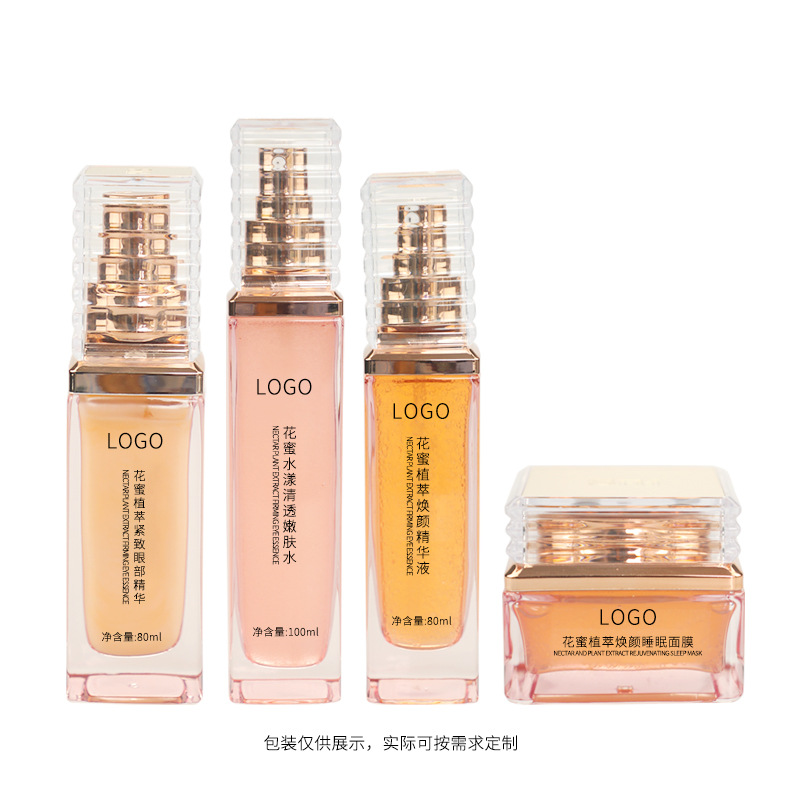
Minimum order quantity is a separate discussion, usually governed by three constraints: the smallest batch a raw material supplier will ship, the economic run size of the filling line, and the tooling threshold for custom packaging. Of the three, packaging is normally the hardest constraint and the one most worth reviewing early. A brand that cannot commit to a custom pack yet can often launch on a stock component and move to a bespoke format once volume supports it. Reference formats are listed in the product range, and one existing set is this moisturising skincare set.
Stage Three: Sampling and Iteration
Sampling should be requested as two or three variants at once. A single sample gives a yes or no answer, while a set of three gives a direction, and direction is what shortens the process. Comparing variants on the same day with the same panel produces more usable information than serial single samples.
Evaluate samples in realistic conditions rather than at a laboratory bench. Cleansers should be tested with wet hands, moisturisers through a full day, and anything applied before makeup tested in that sequence. A sample that feels correct in isolation can fail in the routine the customer will actually follow.
How many rounds to budget for
Two rounds is a realistic expectation for a straightforward product; three or more usually indicates a brief that was not specific enough. Brand owners should plan the launch date around the second round and keep the third as contingency, rather than the reverse. Building contingency into the schedule costs nothing, while discovering it after packaging artwork is printed costs a great deal.
Stage Four: Testing, Registration and Packaging
Stability and preservation testing run in parallel with packaging development, not after it. Stability work normally covers three temperature conditions and is run on the finished pack, because the pack is part of the system. Testing bulk content alone leaves the packaging interaction unverified, which is where a large share of late-stage failures appears.
Registration requirements differ by market and should be confirmed before artwork is finalised, since label wording is often the item that has to change. Registration is a design input rather than a downstream formality. Production conditions relevant to testing and filling are described in the workshop overview, and manufacturer credentials appear on the about us page.
Stage Five: Pilot Batch and Bulk Release
A pilot batch exists to prove that the formula behaves at scale. The variables that matter are not only chemical: mixing shear, cooling rate and filling temperature all shift texture in a light emulsion, and those shifts appear at volume rather than in a sample jar. Batch-to-batch consistency is what a pilot batch actually tests.
Before bulk release, confirm retained samples, test reports, quantities and pack storage conditions. Retained samples are the reference point in any later dispute, and arranging them at the pilot stage is simple while arranging them retrospectively is often impossible. Confirm retention arrangements in writing before the first bulk run, not after the first complaint. Send your brief through the contact page to start the sequence.
A private label project is a sequence of decisions with dependencies, and the critical path usually runs through packaging and registration rather than through manufacturing. Fix the brief, review the cost breakdown, plan for two sampling rounds and confirm retention terms in writing. Projects that finish on time are the ones where the decisions were made in the right order.
Frequently asked questions
Can you produce Private Label Project Timeline under our own brand?
Private Label Project Timeline is handled as a private label project: you bring the brand and the market position, we cover formula, bulk, filling and packing. Existing bases can be adjusted for texture, fragrance and active level, or we develop from a new brief. Tooling and artwork belong to you, and our name does not appear on the pack.
What is the minimum order quantity?
MOQ is set by net fill per unit, not by category:
| Net fill | MOQ |
|---|---|
| < 15 ml/g | 5,000 pcs |
| 15-50 ml/g (50 included) | 3,000 pcs |
| 50-200 ml/g (200 included) | 2,000 pcs |
| > 200 ml/g | 1,000 pcs |
Several SKUs in one project can share a production run to reach the threshold, and a smaller trial order is possible once the formula is approved.
How long do samples and bulk production take?
Samples take 7-10 working days from a confirmed brief, or 10-15 days when a new mould or artwork is involved. Bulk runs 25-35 days after sample approval and packaging arrival. Repeat orders with an unchanged formula usually move faster.
Which certificates and documents come with the shipment?
The plant runs under GMPC and ISO 22716 with a 100,000-class cleanroom. Each shipment can include COA, MSDS, the full INCI list, stability data and microbiological reports. For the EU we support CPSR and PIF paperwork; for other markets we prepare the file set your importer asks for.
Can we change the formula, fragrance or packaging?
Yes. Texture, viscosity, fragrance, colour and active percentage are adjustable within regulatory limits. Packaging can be sourced by you or by us: tubes, airless bottles, jars, sachets and aluminium foil bags, with silkscreen, hot stamping or label application.
What information do you need to quote?
Category and target function, quantity per SKU, packaging direction, destination market and launch date. With that we reply within 24 hours on business days with feasibility, MOQ and a price range. An NDA can be signed before formulas are discussed.
Need this produced? Talk to the factory.
Wangsha Bio has run OEM/ODM production since 2006: 60,000 sqm plant, 17 lines, 100,000-class cleanroom, GMPC and ISO 22716 certified. Send your brief and we reply within 24 hours on business days with feasibility, MOQ and a price range.
Email lucky@moksha-bio.com | Product range | Workshop