Qingyuan moksha Biotechnology Co., Ltd


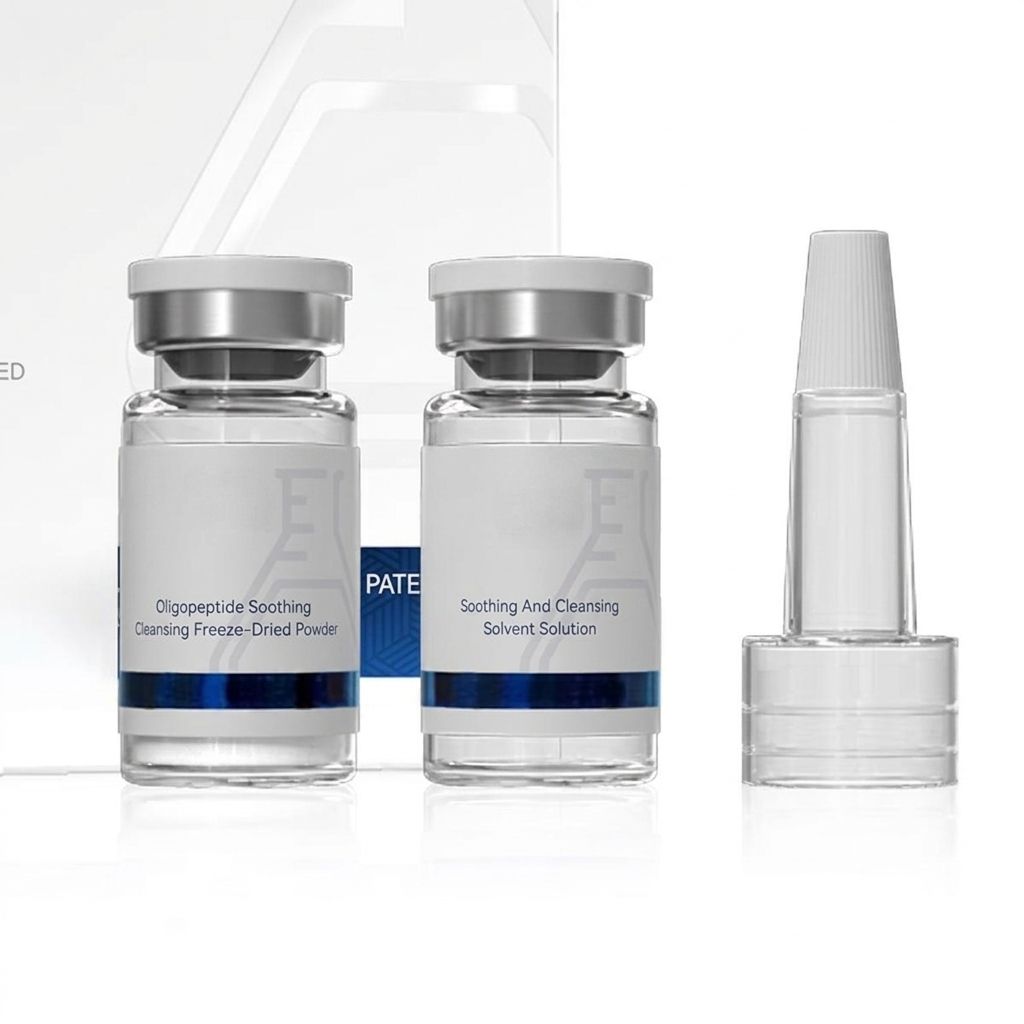
Freeze-dried powder serums and ampoule formats both rest on the same idea: keep the active ingredient away from the liquid until the moment of use. Splitting a formula into two parts lowers the stability burden on the ingredient and shifts the difficulty into the process and the pack. In this category the process and the container decide whether the ingredient arrives intact, not the ingredient name on the front of the box.
Why Split the Formula at All
Peptides, protein-derived materials and several vitamin derivatives degrade in water within weeks at ambient temperature. Removing water slows those reactions dramatically, and a lyophilised powder can hold its specification far longer than the same ingredients in solution. Lyophilisation buys storage time through process rather than through a stronger ingredient.
An ampoule takes the opposite route: it keeps a concentrate in a small sealed container and mixes it with a base liquid at the point of use. The user experience is closer to a conventional serum, with no dissolution step. Both routes solve the same problem, and the choice depends on positioning and channel rather than on chemistry. Reference formats in the current range are listed under the product range, and one powder example is this freeze-dried powder serum.
Lyophilisation Parameters That Matter
Freeze-drying is not low-temperature drying. The freezing rate sets the ice crystal structure, and larger crystals damage fragile structures. Primary drying controls the sublimation rate through vacuum level and shelf temperature, while secondary drying removes bound water down to the target figure. Once a lyophilisation curve is validated it becomes part of the process, and compressing the cycle between batches changes the product.
Residual moisture and cake appearance
Residual moisture above target accelerates degradation, while moisture below target makes the cake brittle and hygroscopic. A conforming cake is uniform, does not collapse and does not adhere to the wall of the vial. Residual moisture and appearance are normally released together, because both reflect the stability of the same process.
Aseptic Fill and Microbial Control
Filling is the second risk line. Open filling, filtration method and container preparation together decide whether the finished unit meets its microbiological target. Ampoules are usually produced by terminal treatment or by aseptic filling; the first constrains the heat tolerance of the formula, the second raises the requirement on the filling environment. The fill route has to be chosen before the formula is locked, because the two routes accept different ingredients.
Container preparation cannot be skipped. Annealing quality in glass affects pressure resistance, and the internal surface treatment of a plastic single-dose vial affects adsorption of the active. Treatment method and validation documents from the container supplier belong in the project file. Filling and cleanroom conditions are described in the workshop overview.
Protecting the Active and Pack Format
Powder products are normally mixed with a solvent before use, and stability after mixing becomes the new question. How long the mixed product remains usable is a specification item, not something the user should work out. Time after mixing is part of the product design and needs a documented number.
A buffer system that fixes pH in a suitable window, plus antioxidant support, is the usual approach. pH and antioxidant support should be validated together with the active, because testing each item alone proves very little.
Single-dose packs and routine use
The pack decides how the user first meets the product. Opening force, flow when dispensed and whether one unit covers one application all affect repeat purchase. Pack handling should be tested with real units before the bulk order, not discovered through customer reviews.
Stability, Release and Specification Items
A stability programme for this category covers three parts: accelerated testing of the powder, a short-term observation of the mixed liquid, and integrity testing of the final container. Missing any one of the three tends to surface as a complaint rather than a laboratory finding. Putting the post-mixing observation into the stability plan is the item most often forgotten in this category.
Release testing usually includes appearance, residual moisture, microbiological limits and pH after mixing. Manufacturer capability is described on the about us page, and briefs can be sent through the inquiry form.
Freeze-dried and ampoule formats sell on the promise that the ingredient is intact. Get the curve, the fill route and the pack validated together and the format stops being a novelty and becomes a repeat purchase.
Frequently asked questions
Can you produce Freeze-Dried Powder Serums and Ampoule Formats in Private Label under our own brand?
Freeze-Dried Powder Serums and Ampoule Formats in Private Label is handled as a private label project: you bring the brand and the market position, we cover formula, bulk, filling and packing. Existing bases can be adjusted for texture, fragrance and active level, or we develop from a new brief. Tooling and artwork belong to you, and our name does not appear on the pack.
What is the minimum order quantity?
MOQ is set by net fill per unit, not by category:
| Net fill | MOQ |
|---|---|
| < 15 ml/g | 5,000 pcs |
| 15-50 ml/g (50 included) | 3,000 pcs |
| 50-200 ml/g (200 included) | 2,000 pcs |
| > 200 ml/g | 1,000 pcs |
Several SKUs in one project can share a production run to reach the threshold, and a smaller trial order is possible once the formula is approved.
How long do samples and bulk production take?
Samples take 7-10 working days from a confirmed brief, or 10-15 days when a new mould or artwork is involved. Bulk runs 25-35 days after sample approval and packaging arrival. Repeat orders with an unchanged formula usually move faster.
Which certificates and documents come with the shipment?
The plant runs under GMPC and ISO 22716 with a 100,000-class cleanroom. Each shipment can include COA, MSDS, the full INCI list, stability data and microbiological reports. For the EU we support CPSR and PIF paperwork; for other markets we prepare the file set your importer asks for.
Can we change the formula, fragrance or packaging?
Yes. Texture, viscosity, fragrance, colour and active percentage are adjustable within regulatory limits. Packaging can be sourced by you or by us: tubes, airless bottles, jars, sachets and aluminium foil bags, with silkscreen, hot stamping or label application.
What information do you need to quote?
Category and target function, quantity per SKU, packaging direction, destination market and launch date. With that we reply within 24 hours on business days with feasibility, MOQ and a price range. An NDA can be signed before formulas are discussed.
Need this produced? Talk to the factory.
Wangsha Bio has run OEM/ODM production since 2006: 60,000 sqm plant, 17 lines, 100,000-class cleanroom, GMPC and ISO 22716 certified. Send your brief and we reply within 24 hours on business days with feasibility, MOQ and a price range.
Email lucky@moksha-bio.com | Product range | Workshop