Qingyuan moksha Biotechnology Co., Ltd


Most contract manufacturing discussions focus on price, lead time and sample quality. Ownership of the formulation is discussed far less often, and it is the term that decides whether a brand is building an asset or renting one. A brand that does not control its formulas cannot move supplier, cannot defend its differentiation and cannot sell the business on the strength of its products. This guide covers the intellectual property terms worth settling before development starts.
Where the Formula Comes From Decides Who Owns It
Three situations appear in practice: the brand uses a standard formulation from the manufacturer's library; the brand asks the manufacturer to modify a library formulation; or the brand commissions a new development or supplies its own formula. Each situation leads to a different ownership outcome, and the difference has to be stated explicitly rather than assumed.
In the first case, ownership normally stays with the manufacturer and the brand receives a licence to sell the product, which may or may not be exclusive. In the second, the parties need to agree on what counts as a modification and who owns that portion, since the boundary is rarely clear in a formula that has been adjusted across several rounds. In the third, the development result is usually assigned to the brand by written agreement, with the manufacturer retaining defined rights. Naming the scenario in the contract prevents the argument that most commonly arises two years after launch. Manufacturer capability and in-house development work are summarised on the about us page.
Exclusivity: Scope, Territory and Duration
Exclusivity is the term a brand should pursue once it has funded development. It usually takes one of two forms: the manufacturer may not supply the formulation to another customer, or the manufacturer may not sell a competitive product in a defined territory or channel. An exclusivity clause is only useful if its scope, territory and duration are specific enough to be measured.
Exclusivity also has a price. An open-ended, permanent restriction limits the manufacturer's ability to load its lines, and in practice that has to be balanced by a volume commitment or a development fee. Exclusivity and purchase commitments belong in the same conversation, because neither stands well on its own.
Raw material dependency
If a formula depends on a specific raw material or supplier, the exclusivity has to extend to that dependency. A manufacturer that changes raw material supplier while keeping the same formula text can still change the finished product. A change-notification clause covering raw materials is the companion term that makes exclusivity meaningful.
Documentation the Brand Should Receive
The documentation package determines what the brand can do independently. It typically includes the formula record, raw material safety documentation, test reports, stability data and the key process parameters. A brand without the technical file has left the product line's future in someone else's hands.
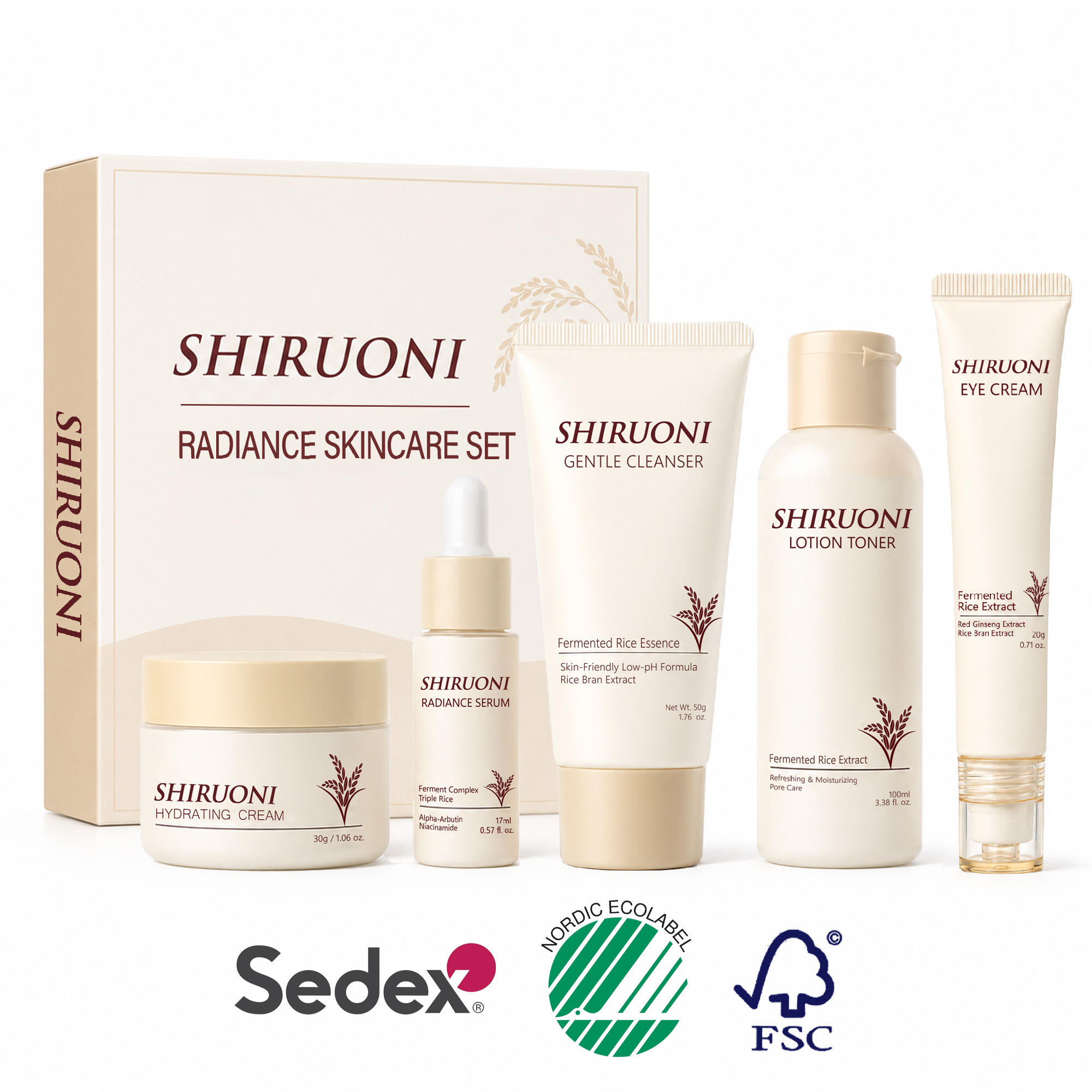
The scope and format of delivery should be agreed in writing: whether electronic copies are provided, whether process parameters are included, and whether the brand may nominate a third party to manufacture if capacity becomes constrained. Attaching the deliverable list as a schedule to the agreement is far more effective than negotiating items individually later. Production capability across several formats is described in the workshop overview, and a multi-item reference product is shown here: five-in-one facial care kit.
Change Control and Quality Terms
Formulations change after approval. Raw materials are discontinued, regulations are updated and costs move, and any of these can trigger a revision. The agreement should state how changes are notified, whether the brand has a right of approval, and whether stability and challenge testing must be repeated after a change. A right of approval over formulation changes costs the brand nothing and prevents the most expensive kind of surprise.
Quality terms should cover release testing, retention sample duration, batch traceability and the process for handling a deviation. Without traceability written into the agreement, a problem becomes an exchange of opinions rather than an investigation.
A Practical Order for the Negotiation
Negotiations stall more often from sequence than from substance. A workable order is to settle the cooperation model and the development investment first, then ownership and exclusivity, and finally change control and quality terms. Discussing ownership before the model is agreed tends to loop indefinitely.
Anything that affects cost or schedule should be in writing. Raw material sources, development timelines and the number of sampling rounds are frequently misunderstood when they are left verbal. If a commitment moves cost or a date, it belongs in the agreement or in a signed development memo. Requirements can be submitted through the inquiry form, and a project can be scoped through the contact page.
Ownership is usually treated as a late-stage topic, but it determines whether a brand ends up with a product range or a set of rented recipes. Settle ownership, exclusivity and change control at kick-off, and every subsequent decision becomes easier.
Frequently asked questions
Can you produce Formulation Ownership and IP Terms in Private Label Supply Agreements under our own brand?
Formulation Ownership and IP Terms in Private Label Supply Agreements is handled as a private label project: you bring the brand and the market position, we cover formula, bulk, filling and packing. Existing bases can be adjusted for texture, fragrance and active level, or we develop from a new brief. Tooling and artwork belong to you, and our name does not appear on the pack.
What is the minimum order quantity?
MOQ is set by net fill per unit, not by category:
| Net fill | MOQ |
|---|---|
| < 15 ml/g | 5,000 pcs |
| 15-50 ml/g (50 included) | 3,000 pcs |
| 50-200 ml/g (200 included) | 2,000 pcs |
| > 200 ml/g | 1,000 pcs |
Several SKUs in one project can share a production run to reach the threshold, and a smaller trial order is possible once the formula is approved.
How long do samples and bulk production take?
Samples take 7-10 working days from a confirmed brief, or 10-15 days when a new mould or artwork is involved. Bulk runs 25-35 days after sample approval and packaging arrival. Repeat orders with an unchanged formula usually move faster.
Which certificates and documents come with the shipment?
The plant runs under GMPC and ISO 22716 with a 100,000-class cleanroom. Each shipment can include COA, MSDS, the full INCI list, stability data and microbiological reports. For the EU we support CPSR and PIF paperwork; for other markets we prepare the file set your importer asks for.
Can we change the formula, fragrance or packaging?
Yes. Texture, viscosity, fragrance, colour and active percentage are adjustable within regulatory limits. Packaging can be sourced by you or by us: tubes, airless bottles, jars, sachets and aluminium foil bags, with silkscreen, hot stamping or label application.
What information do you need to quote?
Category and target function, quantity per SKU, packaging direction, destination market and launch date. With that we reply within 24 hours on business days with feasibility, MOQ and a price range. An NDA can be signed before formulas are discussed.
Need this produced? Talk to the factory.
Wangsha Bio has run OEM/ODM production since 2006: 60,000 sqm plant, 17 lines, 100,000-class cleanroom, GMPC and ISO 22716 certified. Send your brief and we reply within 24 hours on business days with feasibility, MOQ and a price range.
Email lucky@moksha-bio.com | Product range | Workshop