Qingyuan moksha Biotechnology Co., Ltd


Kojic acid and turmeric are the two ingredients brand owners most often pair when they want a brightening story with a natural signal. Both are widely available, both carry consumer recognition, and both create the same difficulty in production: the formula wants to change colour. A cream that shifts from cream to tan over eight weeks does not fail a lab test, but it does fail a shop shelf. In this category colour stability is the formulation problem, and appearance is the primary quality attribute.
Why Brightening Liquids Drift in Colour
Colour drift in brightening formulas comes from three sources: oxidation of unsaturated or phenolic materials, chelation of metal traces picked up from water and equipment, and pH drift during storage. The three interact, so a formula that only addresses one of them will still shift. Treating colour stability requires controlling oxygen exposure, metal ions and pH at the same time.
Pack choice matters as much as the formula. A clear bottle on a lit shelf transmits the energy that starts the reaction, and a wide-mouth jar lets the headspace air exchange with every use. An opaque or pumped pack is often the cheapest available improvement to shelf-life colour, and it costs less than reformulating.
Kojic Acid: Solubility, Heat and pH
Kojic acid is water-soluble and heat-sensitive, which constrains where it can be added in the process. Adding it into a hot water phase shortens its usable life before the batch is even filled, so late-stage addition at a reduced temperature is the usual route. It also chelates metal ions, which is helpful for stability but can interfere with colour systems and some actives. For kojic acid the process parameters are part of the specification, not an internal detail for the factory to choose.
Its effective pH window is narrower than many other brightening actives, which then constrains the preservation choices available. Formulation work on this material usually runs the pH question and the preservation question together rather than in sequence. Decide the pH window first, then pick actives and preservation that can live inside it.
Turmeric and pigment load
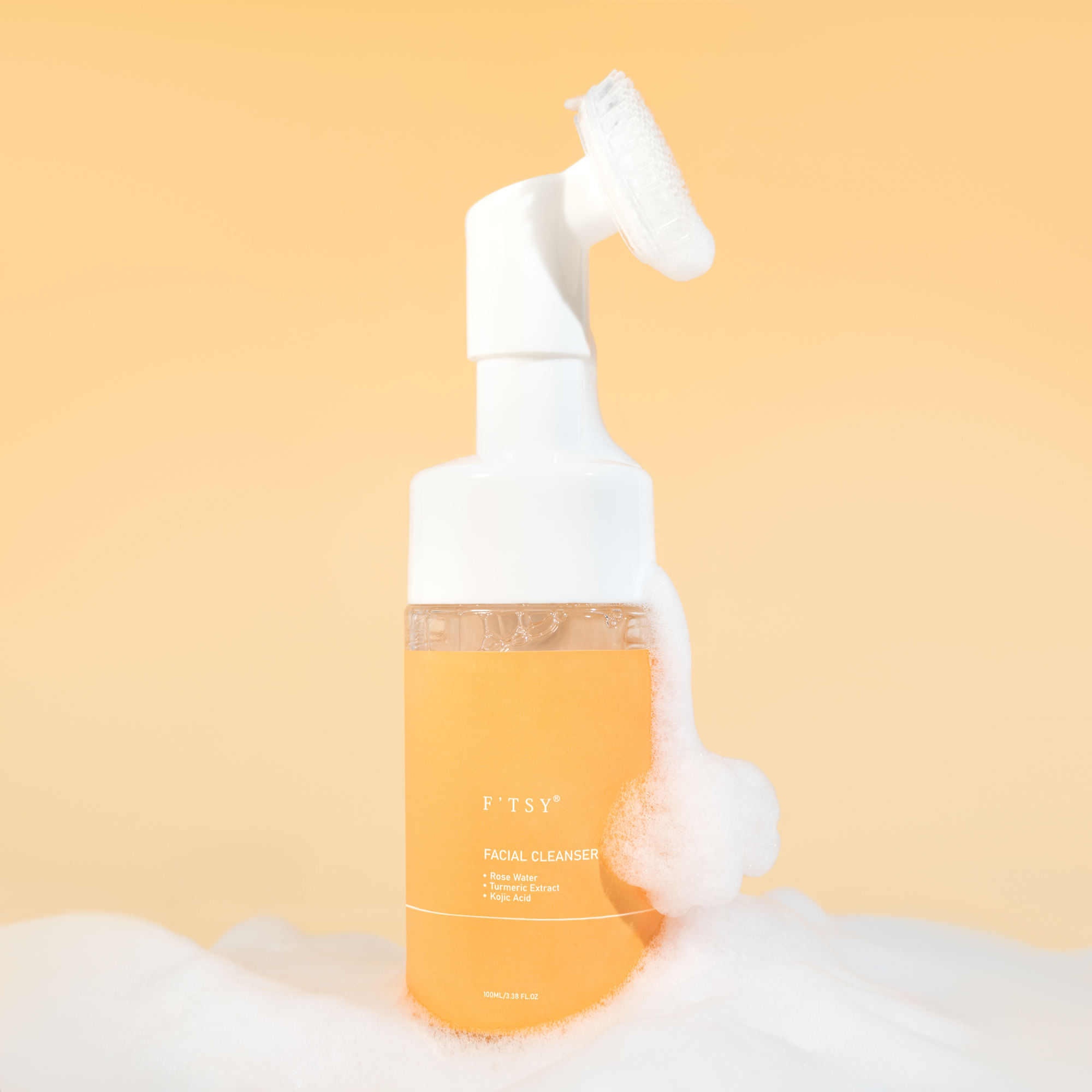
Turmeric-derived materials bring their own colour into the formula, and load level directly decides the shade of the finished product. That is a marketing decision as much as a technical one, and it should be made early. Batch-to-batch colour variation of the raw material also transfers to the finished goods, so an acceptable colour range needs to be agreed in advance. A related format is shown in this turmeric and kojic acid cleanser.
pH, Chelation and Antioxidant Support
Because several brightening actives work best in an acidic environment, chelating agents and antioxidant support systems are standard in these formulas. Chelation reduces the metal-catalysed reactions that darken a product, and antioxidant support limits oxidative change. Both can interfere with preservation systems or with the viscosity of a gelling agent. Add chelation and antioxidant support as designed components, not as insurance added at the end.
Water quality deserves a mention because it is invisible in the formula sheet. Metal ion content in the process water varies between sites and seasons, and it changes how quickly a brightening product darkens. Water specification belongs in the batch record for this category, because it is a raw material with a variable composition.
Preservation, Compatibility and Testing
Water-rich, acidic formulas with botanical inputs carry a high microbiological risk, and the acidic pH narrows the list of preservation systems that work well. Where the positioning allows, a sealed pump reduces the dependence on the preservative system by removing the user's fingers from the product. Where the same formula passes in a pump and fails in a jar, only the finished pack counts.
Stability work should run on the finished pack at three temperatures plus a light-exposure condition, with colour measured at every checkpoint rather than only at the start and the end. Where a botanical input is used, incoming colour and microbiological limits should be specified. An agreed colour range at each checkpoint turns a subjective argument into a measurable specification. Manufacturing and cleanroom conditions are described in the workshop overview.
Claim Discipline and the Specification List
Brightening claims sit close to the line in most markets. Language describing appearance, tone evenness and radiance is normally supportable, while wording implying a physiological effect should be removed. A percentage figure printed on the pack needs a documented basis, and research on a raw material is not evidence of a finished-product effect. A claim should be written while the formula is still open, so the supporting work is scheduled with the project.
Four items belong in the written specification: the colour range permitted at each stability checkpoint, the incoming limits for the botanical input, the challenge test method on the finished pack, and the pH range with its tolerance. Manufacturer capability is described in the workshop overview, credentials appear on the about us page, and specifications can be submitted through the inquiry form.
Kojic acid and turmeric deliver a strong story and a demanding formula. Control oxygen, metal ions and pH, choose the pack early, measure colour at every checkpoint, and keep claims inside the evidence. In this category the product that still looks right at month twelve is the one that keeps its rating.
Frequently asked questions
Can you produce Kojic Acid and Turmeric Brightening Formulas under our own brand?
Kojic Acid and Turmeric Brightening Formulas is handled as a private label project: you bring the brand and the market position, we cover formula, bulk, filling and packing. Existing bases can be adjusted for texture, fragrance and active level, or we develop from a new brief. Tooling and artwork belong to you, and our name does not appear on the pack.
What is the minimum order quantity?
MOQ is set by net fill per unit, not by category:
| Net fill | MOQ |
|---|---|
| < 15 ml/g | 5,000 pcs |
| 15-50 ml/g (50 included) | 3,000 pcs |
| 50-200 ml/g (200 included) | 2,000 pcs |
| > 200 ml/g | 1,000 pcs |
Several SKUs in one project can share a production run to reach the threshold, and a smaller trial order is possible once the formula is approved.
How long do samples and bulk production take?
Samples take 7-10 working days from a confirmed brief, or 10-15 days when a new mould or artwork is involved. Bulk runs 25-35 days after sample approval and packaging arrival. Repeat orders with an unchanged formula usually move faster.
Which certificates and documents come with the shipment?
The plant runs under GMPC and ISO 22716 with a 100,000-class cleanroom. Each shipment can include COA, MSDS, the full INCI list, stability data and microbiological reports. For the EU we support CPSR and PIF paperwork; for other markets we prepare the file set your importer asks for.
Can we change the formula, fragrance or packaging?
Yes. Texture, viscosity, fragrance, colour and active percentage are adjustable within regulatory limits. Packaging can be sourced by you or by us: tubes, airless bottles, jars, sachets and aluminium foil bags, with silkscreen, hot stamping or label application.
What information do you need to quote?
Category and target function, quantity per SKU, packaging direction, destination market and launch date. With that we reply within 24 hours on business days with feasibility, MOQ and a price range. An NDA can be signed before formulas are discussed.
Need this produced? Talk to the factory.
Wangsha Bio has run OEM/ODM production since 2006: 60,000 sqm plant, 17 lines, 100,000-class cleanroom, GMPC and ISO 22716 certified. Send your brief and we reply within 24 hours on business days with feasibility, MOQ and a price range.
Email lucky@moksha-bio.com | Product range | Workshop